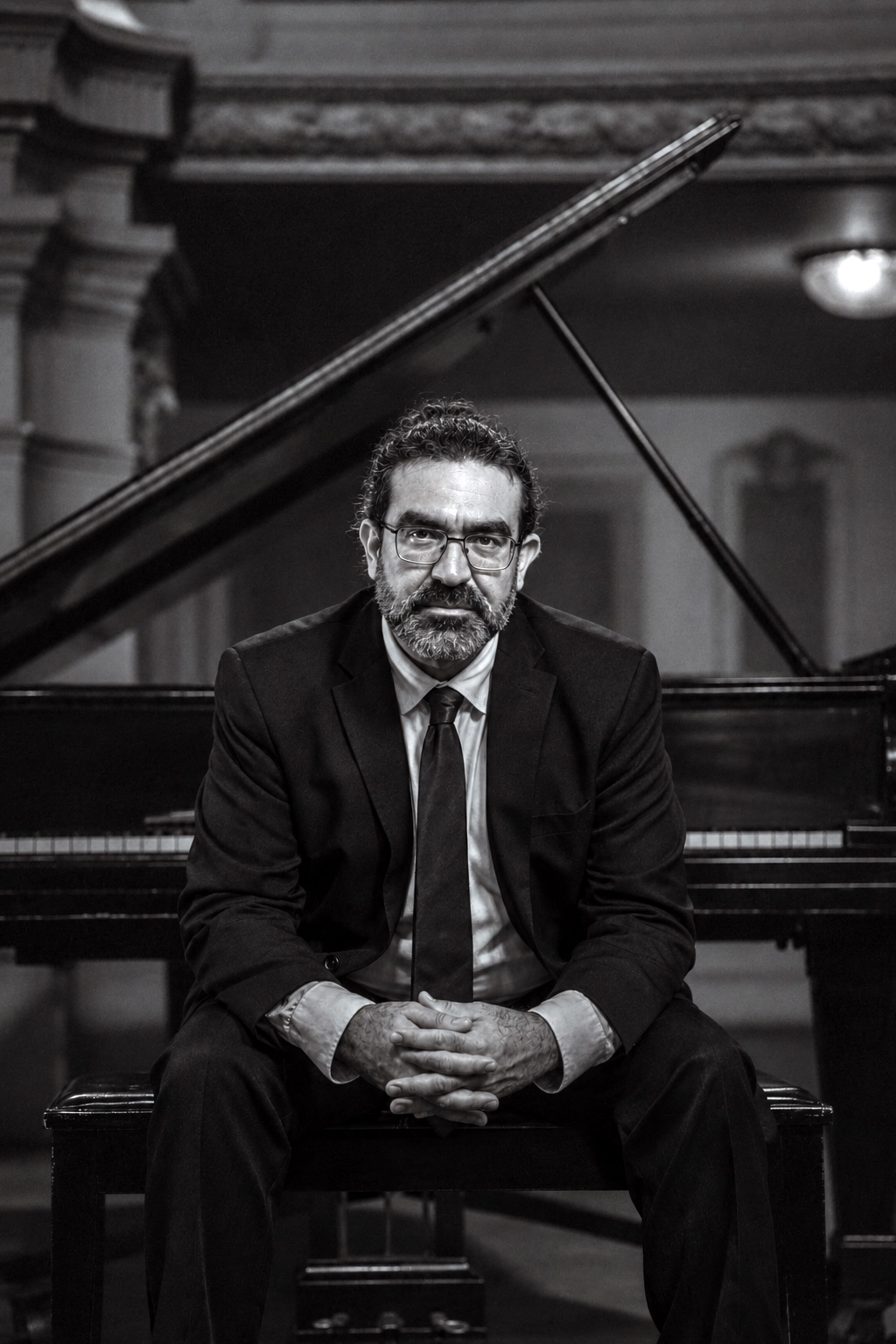
Eduardo Henrique: From Rio to Paris, Searching for a Philosophy Without Words
Eduardo Henrique’s musical journey began with a gift that was never meant to launch a concert career: a small four-octave electronic keyboard that arrived at his family home when he was eight.
“Music wasn’t only what I studied obsessively in order to perform at the piano — it was, more than anything, an inner search about my own life.”
There was no musical family behind him, no established tradition to inherit, and, in the world where he grew up, music was hardly regarded as a realistic profession. What Eduardo had instead was curiosity. He wanted to understand what was happening beneath his fingers — how a handful of keys could become harmony, movement, emotion.
That curiosity took him from a church in Rio de Janeiro to his first real piano at fourteen, from the classical conservatory to the jazz and bossa nova life of the city, and eventually into university classrooms, doctoral research and the solitary world of composition.
But perhaps the most interesting part of Eduardo’s story is that these worlds never cancelled one another out.
Bach could coexist with bossa nova. Chopin could meet Bill Evans. Improvisation could become the raw material for a carefully considered composition. And philosophy could find its way into music without requiring a single spoken word.
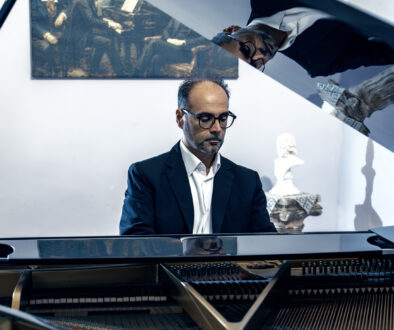
Today, Eduardo describes his compositions as a kind of “philosophy without words.” In April 2027, he brings that evolving language to Paris for his first appearance with Piano Revenge Festival — at a moment when his own musical life is entering a new chapter, from years of accompanying and teaching toward the increasingly personal territory of the solo pianist and composer.
PianoRevenge MAG: Before the pianist and composer you are today, there was a young Eduardo discovering the piano. What was your childhood like, and what first allowed your relationship with music to develop?
Eduardo Henrique: I didn’t come from a family of musicians — where I grew up, music wasn’t even really seen as a viable profession. But my relationship with music began almost by accident, at age 8, when my mother received a small 4-octave electronic keyboard as a gift. I became fascinated trying to understand how music could come from those keys, and I taught myself the basics using simple instructional booklets I could find.
That curiosity grew, and I started playing at a Protestant church my family attended, where a few musicians there taught me my first chords. Noticing how much I loved it, the church eventually offered to sponsor formal piano lessons at a small local conservatory in Rio de Janeiro, since my family couldn’t afford it themselves. That’s how, at 14, I touched a real piano for the first time — and from that day on, my desire to become a concert pianist grew exponentially, and learning piano became a life goal.
At the conservatory, I discovered Bach, Mozart, Clementi, Czerny, Villa-Lobos, Bartók, and more. At the same time, at church, I was learning — very practically — how to build chord progressions, improvise, and accompany sacred songs. That constant back-and-forth between classical training and improvised, popular music started shaping my own musical language early on — bringing classical technique into popular music, and vice versa.
After turning 20, I entered university to pursue a bachelor’s degree in piano performance. Classical music remained my foundation, but in parallel, I began performing professionally in jazz big bands and bossa nova ensembles. My ease with sight-reading and harmonic understanding also led me into work as a répétiteur and collaborative pianist — playing orchestral reductions and accompaniment works in concert and chamber music. Alongside this, immersing myself in jazz, bossa nova, samba, and Brazilian music more broadly increasingly captivated me with its richness, and it left a lasting imprint on my playing — while I pursued classical concert repertoire with equal passion.
After completing my bachelor’s, I became a university professor, working essentially as a teacher, collaborative pianist, and répétiteur. I continued into academia, earning a master’s degree and later a doctorate (PhD). That doctorate took six years to complete because of the pandemic — but it was during that time that I delved much more deeply into philosophy, an interest I’ve never let go of since, and one that, in recent years, brought out my composer side: I began composing my own music as a kind of philosophy without words.
You describe music not simply as a profession or artistic choice, but almost as a calling. How did this understanding develop throughout your life, and when did you realize that music was inseparable from your identity?
Choosing music as a profession was never, for me, simply a professional decision. For a long time, I may not even have been fully conscious of that myself. As happens with many of life’s most important decisions, what we later recognize as a calling doesn’t always present itself clearly at first. What I made was a deliberate choice never to move away from the piano again.
Over time, though, I began to realize that something much larger was happening. Music wasn’t only what I studied obsessively in order to perform at the piano — it was, more than anything, an inner search about my own life. Not to explain it, since I let go of that ambition, but to feel it fully. In a sense, I found myself close to a Platonic idea: music as the formation of the soul.
At a certain point, I understood that choosing art as a profession didn’t simply mean choosing a career. It meant taking responsibility for what music had already become in my existence — no longer something I merely practiced, but something that had quietly shaped who I was.
You come from Brazil, a country with an extraordinarily rich musical culture. How has your Brazilian background shaped your musical identity, even as your own artistic language has developed toward classical, neoclassical and contemplative music?
Initially, I was born into a musical environment that wasn’t necessarily rooted in well-known Brazilian musical culture. I was raised in a religious setting where UK-style sacred music and North American gospel culture were strongly predominant. In parallel, from age 14, I studied at a music conservatory, which brought me into the canonical concert repertoire — classical music. I was, at that point, largely unaware of genuinely Brazilian culture, and specifically of Rio de Janeiro’s own musical culture.
My real encounter with typically Brazilian musical culture came later, after I turned 20, when I moved away from that religious environment and entered Rio’s own cultural life — where samba, bossa nova, and the whole range of MPB (Brazilian popular music) began to fascinate me. I fell in love with the culture of my homeland and started playing bossa nova in the nightlife of Rio de Janeiro, alongside many other rich Brazilian styles.
Jazz’s influence in Rio is also very strong within Brazilian music, and I was deeply inspired by that style during those nights in Rio as well — so much so that today we have genres like Brazilian jazz and samba-jazz, which differ from more North American jazz. And all of this unfolded in parallel with my strict academic path within the conservatism of classical, concert music at university.
In this way, I grew musically with a more hybrid language — building professional experience in jazz, musical improvisation, and bossa nova, while simultaneously pursuing piano studies to become a concert pianist. My musical identity at the piano was shaped without real barriers between classical and popular music.
As for “neoclassical” — in the contemporary genre sense used today on streaming platforms like Spotify, which is different from the neoclassical concept as an academic, musicological term in music history — that came into my life more recently. I began composing more minimalist works for solo piano, generally monothematic, but I made a point of developing my themes more fully, so that compositional elements from classical music would still be present in my work.
So when I compose neoclassical music, my focus is on seeking intimacy with my own language, identity, and life experiences — through classical pianistic sound, together with the intimate experience that neoclassical music allows us to bring out.
Your musical influences include Chopin and jazz, particularly Bill Evans. What have these very different musical worlds taught you about expression, and how do they meet within your own artistic voice?
Throughout my entire musical life, I’ve stayed in constant study between jazz — improvisation, harmony, and so on — and the rigorous discipline of classical piano. That’s shaped the way I approach classical music itself: beyond studying it for performance, I’ve always also looked at it through a harmonic, aesthetic, compositional, and textural lens.
With Chopin, it was no different. For me, he was one of the greatest composers to ever write for the piano — his own instrument. I learned to observe and analyze, in his works, his genius in harmonic progressions, modulations, harmonic openings, melodic and agogic nuances, dramatic textures, and so much more. His lyricism is truly unique.
With Bill Evans, it’s his characteristic voicings within his improvisations — quartal harmonies, deeply introspective playing, combining the freedom of modal jazz with the harmonic sophistication of European classical music, among other elements — that taught me to recognize the genius in both of these composer-musicians, even though their paths converge on the very same instrument: the piano.
As a pianist and composer myself, it’s impossible not to bring both of these influences into my own compositions. But understand — my work isn’t a cut-and-paste of each of their techniques. If you listen closely, you’ll notice subtle traces of Chopin’s lyricism alongside subtleties of Bill Evans‘ jazz language — yet everything unfolding within a clear identity of my own.
You are also a piano teacher. What has teaching taught you about music and about people that performing and composing could never have taught you? And what do you believe is the most important thing a teacher can give to a developing pianist?
Throughout my career, I’ve had students come to me with very different interests — some wanting to focus on solo classical piano, others on chamber music or collaborative piano, others looking to learn Brazilian piano styles, and others wanting jazz harmony and improvisation.
Over the years as a teacher, I’ve come to realize that no two students are alike — even when I’m teaching them the exact same material. The musical results that emerge from my lessons always impress me, because there often comes a moment where I ask them to explain to me how they arrived at a particular way of playing something. In that moment, I essentially become a student of my own students. I’m always learning from them.
If there’s one thing my teaching career has taught me, it’s that each person’s musical and artistic plurality is unique. Every student brings a different perspective to the very same lesson I teach — and from that, like a prism, new musical conceptions keep emerging.
At the university where I work, here in Rio de Janeiro, I remain an eternal learner, because for every answer I give my students, they come back with new questions I would never have thought to ask myself.
In the end, teaching — especially musical teaching — is deeply rewarding, because the human relationship it creates enriches the art itself. Over time, we help turn many students into true artists and thinkers. And the most important thing I believe I can pass on to a piano student is that making music goes far beyond technique, and beyond the protocols written on a score.
When you compose, where does a new piece begin for you — a melody, an emotion, a philosophical idea, an image, or perhaps simply a moment at the piano? Could you take us inside your creative process?
First of all, I should say that my compositions don’t come from a programmatic method, nor from any specific technical-compositional search. My works begin with improvisation. I have a habit of recording at home, without much concern, a great deal of what I improvise, with no predetermined musical intention.
I’d say my compositions go through this improvisational phase, and they aren’t structured beforehand in anticipation of arriving at something ready to be written down on a score. Of course, every improvisation carries its own real-time structured thinking for that immediate act of composing — but I’m certain that if I stopped to think through it part by part, interrupting the flow of ideas, the result would be entirely different. So the process of shaping my compositions only takes structure afterward, starting from this “raw material” that improvisation initially brings me.
Beyond that, I can say that all of my works begin with a philosophical idea — since I’m an avid reader of philosophy, I’d say my music is an ontological search about life, about myself, about my own reflections, about the way I look at the world, or at least an attempt to imagine the world through sound. In this way, the unfolding of my creative process, up until it becomes a finished piece, is essentially a search for a “philosophy without words” — or rather, the only word that remains is the title itself, because it’s the philosophical key that set in motion an entire ontological search into life’s questions, one that seeks transcendence, and which, for me, manifests itself in music.
Your works Endurance, Reflections on Time and Dream of Peace carry ideas that seem to extend far beyond music. What personal experiences or questions lie behind these compositions, and what do these pieces mean to you today?
Each of these three pieces was born from a very specific personal experience or reflection — and together, they will make up the three tracks of my EP, Quiet Passage, coming soon to Spotify, released independently through my own label, Piano on Time.
Reflections on Time is my first neoclassical work, and beyond having a more delicate compositional construction, it’s also a more philosophical piece — one that contemplates the idea of eternity within the present moment. This idea draws directly from Saint Augustine, who wrote that “time is only time because we measure it; otherwise, it would be eternity.” For our fast-paced everyday lives, that’s almost a paradox: the present as eternity. In this piece, it’s essential to understand that eternity isn’t infinite time, but rather the absence of counted time — a present that never becomes past. What remains, then, is an eternal present: an instant of consciousness that doesn’t move on as long as we’re listening to the music. In short, the piece isn’t concerned with time as chronos — measured, sequential time — but rather something closer to kairós: a more qualitative, meaningful duration. The piece carries this idea of eternity found in the contemplation of timeless cycles, and in the quiet weight of life as an eternal present.
Endurance came as a response to my many years as a répétiteur and collaborative pianist — years spent doing sight-readings, rehearsals, and sustaining other people’s solos backstage, without an audience or a spotlight of my own. That experience taught me a kind of silent endurance: the strength to sustain a deeper purpose even when no one is watching. Musically, it’s a more complex work than the first, built on Baroque-style cadential structures and jazz influences within a neoclassical sound, deeply rooted in a post-Romantic pianistic language. It deliberately ends on suspended harmonies that never resolve to the tonic — a way of symbolizing that this endurance keeps echoing on, even after the piece itself has ended.
Dream of Peace proposes an almost philosophical dream of peace — an attempt to draw closer to a feeling of peace through music itself, as if peace were something we could reach and make “tangible” before our very eyes, even briefly, like a dream that felt so real we’re left not knowing whether it was real or a dream. It’s a pianistic soundscape that turns to the contemplation of peace within a dream, rather than simply describing it in words. Compositionally, the harmonic discourse itself becomes the piece’s main theme, coupled with pianistic textures that explore a kind of mantra — through rhythmic ostinatos and small melodic motifs.
Today, these three pieces mean even more to me than when I first wrote them. Together, they trace something like an emotional and philosophical arc — from endurance, to a meditation on time, to the search for peace — and in many ways, they mirror the journey I’ve walked as an artist myself.
You often speak about creating a space of deep listening, where music can exist beyond entertainment. What do you hope happens within the listener during one of your performances, and do you believe music can genuinely transform someone’s inner world?
Yes — I not only believe that, but science itself has already shown that music has a healing effect. Philosophically, music is a mystery that has become the subject of deep study by great thinkers such as Plato, Schopenhauer, Scruton, and others.
To begin answering this question, I’d like to bring in another major philosopher, Theodor Adorno, who drew a distinction between music as art and music as commodity. As I understand it, entertainment carries an industrial character — a kind of music conceived as a product for mass consumption, designed around standardization and repetition, meant simply to entertain. Art, on the other hand, carries no such obligation to entertain. Its role is to provoke reflection and question reality, not merely to amuse or pass the time. Art seeks to pull the listener out of their comfort zone through depth: it deals with complex feelings, blending attraction and discomfort at once. The artist dares to expose themselves and challenge conventions, without worrying about pleasing everyone.
In this sense, what I seek in my performances is introspection — the sense that the listener won’t leave my music the same way they entered it. Because in art, communication transcends the notes and sounds themselves; the flow of communication becomes direct, from the performer’s inner world straight to the listener’s — bringing forth feelings and something that words, alone, could never carry.
As a pianist living in an increasingly digital and AI-driven world, how do you see the future of the acoustic piano and of human musical expression? What do you believe must remain uniquely human in music?
In its original Greek sense, music comes from the Muses — goddesses who inspired memory through the arts. I believe that music, specifically as a work of art, is something genuinely human, and that any artificially generated music is, at best, an elegant average of everything humans have ever created and that was one day made digitally available to AI.
It’s possible to imagine, in the very near future, that AI’s development could trigger a paradoxical shift in the market. By saturating part of the world’s music production with AI, it might actually push real artists out of that streaming zone — and, in doing so, return artists to a more genuinely human, artistic role: as creators of real sonic experiences. In our case, that means the acoustic piano and live performance done by a human being, in real time.
I think this could open a path opposite to the one that’s been consolidating through AI’s growing role as a music producer — a return of music to its immanent condition as free expression, no longer subordinated to the functions of today’s digital market. In that sense, AI wouldn’t just dominate digital fiefdoms — ironically, it might also push the human back toward a more authentic, organic state of musical creation.
Perhaps, on that horizon, we’ll begin to more clearly distinguish two forms of music: one that is genuinely born as art of the soul, and another that adapts itself to the demands of machines, mass production flows, and metrics — a kind of “art-ificial art.” In this way, we’d end up with “human-art” and “art-ificial art” — two poles separated by our contemporary chaos, the fruit of the growing tension between humans and machines.
Ultimately, perhaps the real contemporary challenge isn’t producing more and more tracks to feed playlists, but recovering the possibility of the real — making music for music’s sake. A human-art that exists on its own terms, through the pulse and breath of human experience, and through the revelation of spirit within art. It’s actually with this philosophy in mind that I’ve recently begun building my own music label, Piano on Time — a way of taking that reflection into practice, and reclaiming a more direct, human-scale control over how my music is created, produced, and shared with the world.
Your upcoming participation in Piano Revenge Festival will also be your first experience of Paris. What does this moment represent for you, and when you leave the stage, what would you most like the audience to carry with them from your music?
I can say that I’ve been seeking a “career transition” in my life. As I’ve mentioned in other answers, the greatest demand on my musical life over nearly 30 years as a pianist has been, above all, as a collaborative pianist. In recent years, though, I’ve been pursuing a more solo path — both as a performer and as a composer. Having the opportunity to take part in this festival represents a milestone in my life, because it marks a transition from collaborative pianist to solo pianist performing my own original music.
And since I’ve never been to Paris, it’s a great joy to be able to perform in a place where concert music has such deep roots and history in its European soil. Here in Brazil, interest in concert music and neoclassical music carries far less weight than it does in Europe.
What I’d like the audience to take away from my music is that art can transcend continents — that they might feel something intimate and genuine coming from a pianist born in Brazil, and that my music can lead them to reflect on themselves and on how art can transform lives.