Hélène de la Forêt: The Piano as a River, Music as Discovery
“I am still looking for a world.” — Hélène de la Forêt
Preface
For Hélène de la Forêt, music is not a territory to be conquered but a world that remains permanently open. She describes herself as an explorer, drawn as much to cinema, literature and the movement of images as to the traditions of classical piano. Her artistic path is shaped by curiosity, chance and an instinct to follow sound wherever it leads.
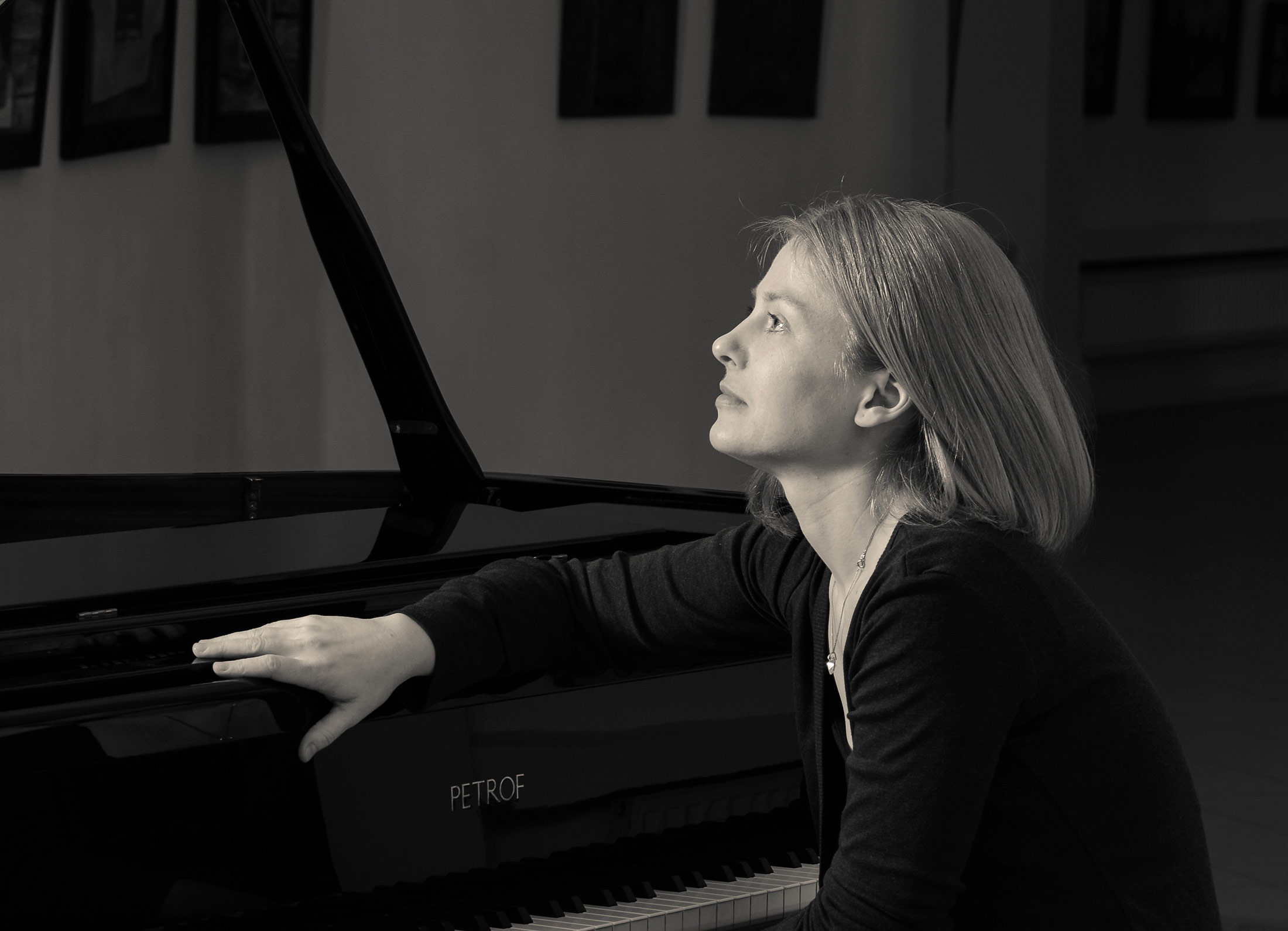
Her relationship with the piano has changed profoundly over the years. What once represented a challenge — a new limit to conquer — has gradually become something more fluid: a medium through which she can “swim”, like a river with its own rules. The task is not to impose herself upon the instrument, but to listen to it and follow it.
This perspective also informs her approach to repertoire and interpretation. Her work with Messiaen’s Vingt Regards sur l’Enfant-Jésus became more than an encounter with one of the monumental works of twentieth-century piano literature; it became a transformative experience that led her deeper into composition and into her own artistic language. At the same time, her growing connection with French music and culture has opened another chapter in her musical exploration since moving to France.
In April 2027, Hélène will join the main selection of Piano Revenge Days in Paris, where she will take a further step into the unknown: it will be her first time improvising live in concert. For an artist who believes so strongly in discovery, uncertainty and the unexpected, the encounter feels particularly appropriate.
At Piano Revenge, where the festival is created by artists, for artists, her approach resonates with the spirit of the project: music as a living act, a collective moment of listening, and a space where the performer and audience can discover something together.
“Live your questions now.” — Rainer Maria Rilke
Editor’s Note
At Piano Revenge MAG, we are particularly interested in artists whose work refuses to remain within a single definition of what a pianist should be. Hélène de la Forêt belongs to this category.
Her words reveal an artist who treats repertoire not as a fixed catalogue but as a field of investigation — one in which classical tradition, improvisation, literature, cinema, composition and chance can coexist. There is also a refreshing humility in her relationship with the instrument: rather than presenting the pianist as its master, she describes the piano as something with its own force and its own rules, something that must first be listened to.
This idea of listening runs through her entire artistic philosophy. It appears in her reflections on Messiaen, in her understanding of performance as a collective act, and in her conviction that the concert becomes truly alive when musician and audience begin listening together.
We are therefore delighted to welcome Hélène de la Forêt to the main selection of Piano Revenge Days in Paris in April 2027. Her first live improvisation within the festival will bring precisely the kind of uncertainty and discovery that continues to make the piano an endlessly contemporary instrument.
Read the full conversation with Hélène de la Forêt below.
PianoRevenge MAG: Let’s begin with you as an artist. How would you describe the musical world you have created for yourself, and what are the ideas or values that guide you most strongly today?
Hélène de la Forêt: I’m still looking for a world, I see myself as an explorer and hope that my search will never end. But I am very influenced by other arts in my improvisations, especially by cinema and literature, I often follow their shapes, or non-shapes, for example a never ending flow of images and rythms, always looking for a story, not after the technique of saying it, but after that hidden sense which can’t be put into words.
My motto would be “if you can explain your music, it is not music anymore”. I am deeply convinced that technique (both pianistic or writing) is necessary, but it comes in time and it is a consequence of the artistic purpose.
Your repertoire and artistic projects move between different periods, styles and approaches to the piano. What makes you choose a particular piece or composer, and what makes you feel that a work belongs to you?
As an explorer of sounds, I believe very much in hazard, I let the life guiding me through different facts and repertoires. So, every project has a life story behind it, this is why every of them becomes unique because it is a mixture between science, my subjective mirror and a chronology of facts which can be also be changed.
About classical music, it’s almost the same, for example now I study the French music chamber repertoire because I moved to France and I believe that it the ideal moment. I feel very close by the Zen philosophy, looking to surprise myself in choosing new repertoires and new ideas and surprise also the ones who will listen.
What does the piano mean to you beyond being an instrument? Has your relationship with it changed over the years?
Well, a lot!… At the beginning, when I was 7 years old and many years afterthat, there was something to fight for, a new limit to conquer… This way the pianist was a sort of hero ! And then I realized I don’t be a hero, not all my life, there was nothing interesting there.
Now the instrument is just a medium into I “swim”, very close to a river which has its own rules, it can be dangerous sometimes, but always it has to be listened and followed… Never impose my own ego or my power, which is so less, because it will always win.
You have developed a strong connection with French music and culture. What is it about the French musical tradition that continues to attract you, and how has it influenced your own artistic identity?
Yes, my relationship with French culture developed very early, since I was a child and reading the novels by Alexandre Dumas and that revolutionary state of mind dominated by “egalité, liberté, fraternité” shaped my way to be ! Then, my vision on French culture changed a bit, and saw it as a “feu d’artifices” which breaks breath, and in the next second nothing rests, afterthat, another burst of light follows and so on !
Claude Debussy “Feu d’artifices” illustrates geniously this French spirit of sparkling moments. There is much dose of superficiality, where the beauty is the purpose itself… This cultural splendour is a result that all kinds of creativity are accepted, fact which explains the huge quantity of works (in art, science, politics and so on) created and the reactivity and interest of “consumer of culture”.
Your interpretation of Messiaen’s Vingt Regards sur l’Enfant-Jésus has been an important part of your artistic journey. What does this work mean to you today, and what do you feel Messiaen can still say to listeners in the 21st century?
Published on Youtube under the name Anca Elena, my performance of Vingt Regards sur l’Enfant-Jésus took place in 2020 and at that time, it was a premiere in Romania. I believe it still is there. I started this project with a lot of curiosity which opened me the way through this monumental work of 20th century. I made more versions of recordings (video live, audio, recital) and afterthat I discovered that this process of analyzing and memorizing his work transformed Messiaen in the grounder of me as composer. Yes, I was expecting to learn a lot about composition technique, but my methamorfosis came very quick.
We know that he had a lot of disciples, some of them brilliant composers, as Pierre Boulez and Yannis Xenakis, so had that gift to build composers. In my case, his power manifestaed after his death, which is a kind of miracle !
Even I still consider that work is so dogmatically conceived, because Messiaen composed this work when he was still young, full of knowledge, professor of composition in Paris, this square and mathematicly conception had the result that I wanted to break my own limits. This is why I am so grateful to this genious composer and for making this project arounded by people which supported my journey ! About Messiaen’s audience in 21th century, I don’t know what to say. He was visionary, he was the first global composer, he announced the peace of all religions, so he was more as a musician ! But the truth is that his works are still difficult to perform and to listen.
They are on the top of difficult repertoire which is played in competitions or universities, studied with much interest… The commun audience is still looking for more comfortable music and he was conscient by that, about the difficulty of perception, because he explained a lot his theories, he assumed the fact that he could be not totally understood.
As a performer, how do you balance respect for the composer’s intentions with the need to bring your own personality and experience into a performance?
I truly believe that it has to be an unity between them ! We really don’t know which really were the composer intentions. There are only some theoretically presumes, very scientific, sometimes difficult to understand them. We didn’t listened for example Monteverdi himself singing. Maybe he was a bad singer, we don’t know. What we have is a score, an instrument and our imagination. Starting from here, all authenticity comes. This way, I’m sure that the composer would have been happy to listen our perfoming creation.
There is an artificial break between the God-composer and the servent-performer. This break could be accepted in pedagogy, but not even there because it is a source of mediocrity. We all serve Music. Having a fake God as only the composer, only the audience or even theories or virtuosity is so far of Music ! And, finally, this is what Messiaen demonstrated during decades: the divine origin of Music, with its language which flows through centuries and rules used by all great composers.
Is there a particular moment on stage — before, during or after a performance — when you feel that the relationship between you, the piano and the audience becomes something different from simply “playing a concert”?
For me playing in a concert is a sort of collective performing creation because all thoughts follow a score… And there is an incredible moment during the concert when, after many months of doubts and preparing, whatever you play, it gets unique and will be understood, that moment when the musician and people around him are listenting together and watching the sound “show” how it is developing, that moment when you are over your subjectivity.
Ther is a dose of danger there because the musician is technically responsible by the success of all this magic show, but if he / she is prepared, there will be an sparkly unforgettable moment.
You have performed and worked in different cultural environments. How does performing for different audiences change your approach, if at all? And what have audiences taught you as an artist?
I am grateful to all people which listened and interacted with my music. Through time, I met all kind of audience, from very hostile like professors in academies, till very enthousiastic like artists I admire. Then, there are places where music sounds better – some magic places with musical tradition and some places where it is treated as a Cinderella by politicians. From all these experiences I learned not to waste my time in wrong places. I learned to respect my audience as my own conscience but, most of all, I learned to offer the gift of music. This is a way for me to pass over the pianists’ stage fright.
I like very much this image reffering to the people outside which are listening and seeing the soloist, that unique person placed in the center of million eyes and ears, which in fact are the his infinite perception on life. This is why he is sometimes so scared.
You will be joining Piano Revenge Days in Paris in April 2027. What does being part of a festival created by artists, for artists, mean to you, and what are you hoping to share with the Piano Revenge audience?
For me it’s a challenge because it will be the first time when I will improvise live, this is why I am so grateful to the concept of this festival, to the artists which are making things happen, they remember me by all avangarde movements, during times when groups of artists were daring to believe in their art.
About the listeners, there will be a mutual exploring and discovery. I’m sure they will be exigent, but in the same time very opened to a pianistic “joie de vivre”.
Looking ahead, what is currently inspiring you most — a composer, a new project, an artistic idea, or perhaps something completely outside music — and where would you like your artistic journey to take you next?
I feel very close to the spirit of Paris, where people know to “lose” their time in cafés and talking face to face, but also listening an useless music or reading a poem, when apparently it seems that no pressure of performance exists. No wars, no worries… And this is that very moment when good ideas come !
Talking about future, I’ll continue my projects started in Romania: a festival, Aerial, which will take place online on Youtube in December 2026, a recital in Vienna for the next year. But I started also to connect with musicians here and have a classical chamber music project…
Every of them will include works composed and improvised by me. I am happy also with my new project as piano teacher in frame of École Française de Piano, a private Conservatory here, in Paris, built for excellence.