Michael Borowski: From Peace Valley to Wander — A Piano in Motion
Across five releases, Michael Borowski has gradually transformed the solo piano from a place of memory into a language of movement — intimate, instinctive and quietly cinematic.
Editor’s note
There are musicians whose work can be understood through technique, genre or influence. And then there are artists whose music is better understood as a landscape — something one enters rather than simply listens to. Michael Borowski belongs to the latter.
His catalogue is intimate without being confessional, melodic without becoming predictable, and deeply personal without asking the listener to know his story in order to feel its meaning. From Peace Valley to Wander, his music traces a gradual movement from memory toward freedom, from stillness toward motion.
Following our recent conversation with Michael for Piano Revenge MAG, we wanted to look beyond a single release and listen to the larger story: how a pianist who grew up surrounded by classical music, discovered George Winston and the world of contemporary piano, worked with Will Ackerman, explored improvisation and performed with bands, has gradually developed a musical language that is unmistakably his own.
The result is not simply a discography.
It is a journey.
Before the journey, there was home
Borowski’s relationship with the piano began remarkably early. His mother was a respected piano teacher, and their home was constantly filled with students, rehearsals and music. He studied formally from childhood through his teenage years, but his musical identity was never confined to the classical tradition.
His ears wandered.
Classical music was joined by rock, jam bands, jazz and the expansive world of contemporary solo piano. One particularly important discovery was George Winston’s December, produced by Will Ackerman — a record that showed Borowski how apparently distant musical worlds could coexist inside a single piano.
That encounter would eventually lead to an extraordinary connection with Ackerman himself, who produced Borowski’s Peace Valley and Gardens of Zion in the Rain.
It is a useful key to understanding his work.
Borowski’s piano has never seemed particularly interested in choosing between worlds.
There is classical discipline, but also the looseness of improvisation. There is the intimacy of the solo instrument, but also the rhythmic energy he has experienced performing with bands and touring musicians. There is composition, but there is always the possibility that the composition might change once he sits down to play it.
This duality is not something he has tried to resolve.
It is the point.

Peace Valley: where memory became music
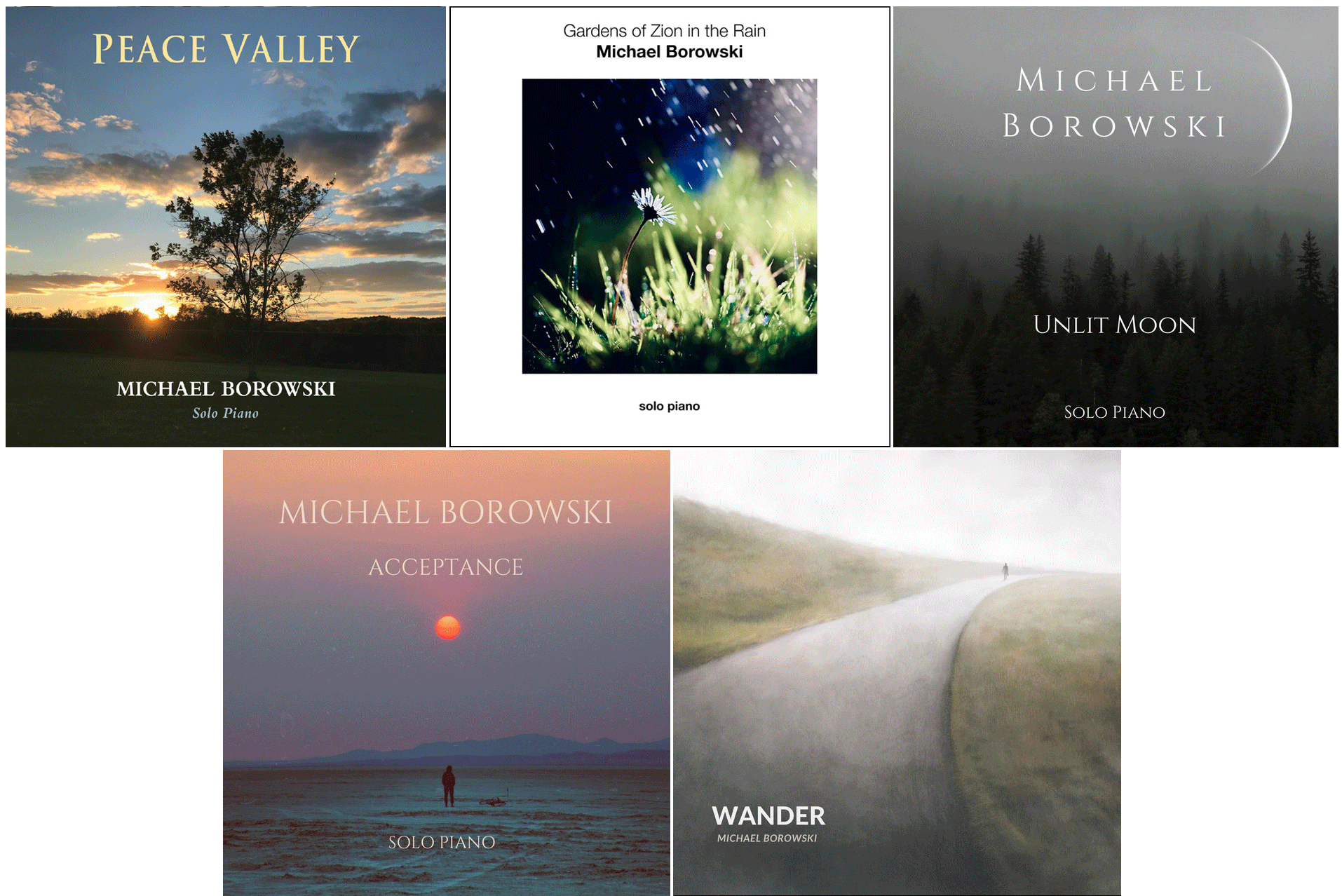
Released in 2020, Peace Valley remains the emotional foundation of Borowski’s catalogue.
The album emerged during an exceptionally complicated period of his life. His mother had lived with Alzheimer’s disease for twelve years, while during those same years his son was born and he met and married his wife.
Loss and beginning occupied the same period.
The album’s title came from a nature preserve near Borowski’s home — a place where he would bike, kayak or simply sit beside the lake. It was also an emotional description of what remained after his mother’s death: the knowledge that her suffering had ended. That dual meaning is important.
Peace Valley is not simply an album about grief. It is about the strange coexistence of grief with gratitude, love with exhaustion, memory with relief. Its emotional world is therefore more complicated than melancholy alone. The piano becomes a place where contradictory feelings can exist without needing to be explained.
Borowski does not tell the listener exactly what to feel. He leaves the door open.
From the personal to the atmospheric
Two years later came Gardens of Zion in the Rain.
If Peace Valley established memory as one of the central forces in Borowski’s music, Gardens of Zion in the Rain deepened the relationship between memory and place. The title itself refers to Zion Memorial Gardens, where his mother is buried. Again, the landscape is real.
But Borowski’s music has a way of allowing the real landscape to become something larger.
Rain, gardens, memory, family — these become emotional coordinates rather than literal narratives. A listener does not need to know the biography behind a title to enter the piece. This is one of the most generous qualities of his music.
The composer supplies the atmosphere. The listener supplies the story.
“The composition is not a cage. It is a map.”
Unlit Moon: darkness without drama
By the time Unlit Moon arrived in 2023, Borowski’s vocabulary had become increasingly recognisable.
There is a particular quality to his writing: melodies remain close enough to the listener to feel immediately human, while the spaces between them are allowed to breathe.
The album does not need grand gestures. Its emotional power often lies in restraint. Even the title Unlit Moon suggests something that exists without demanding to be illuminated. Darkness here is not necessarily despair. It can be privacy, uncertainty, contemplation — the atmosphere surrounding an emotion before it has acquired a name.
Borowski’s music often feels less like a declaration than a recollection.
And recollection is rarely linear.
Acceptance: the space after the storm
Later in 2023 came Acceptance.
Even before hearing a note, the title suggests a shift. After Peace Valley and Gardens of Zion in the Rain, where memory is closely associated with particular people and places, Acceptance seems to move toward a broader emotional state. It is not necessarily resolution. It is something quieter: allowing.
Allowing the past to remain the past. Allowing emotion to exist without having to turn it into explanation. Allowing the piano simply to be a piano.
This is also where the importance of improvisation becomes particularly clear. Borowski has described improvisation not as an occasional embellishment but as an essential part of staying alive inside the performance. He rarely wants to reproduce a recording mechanically. A piece may have a recognisable identity, but the route through it can change. That philosophy gives his music an unusual quality of freshness.
The listener may know the destination. The journey is never exactly the same.
And then: Wander
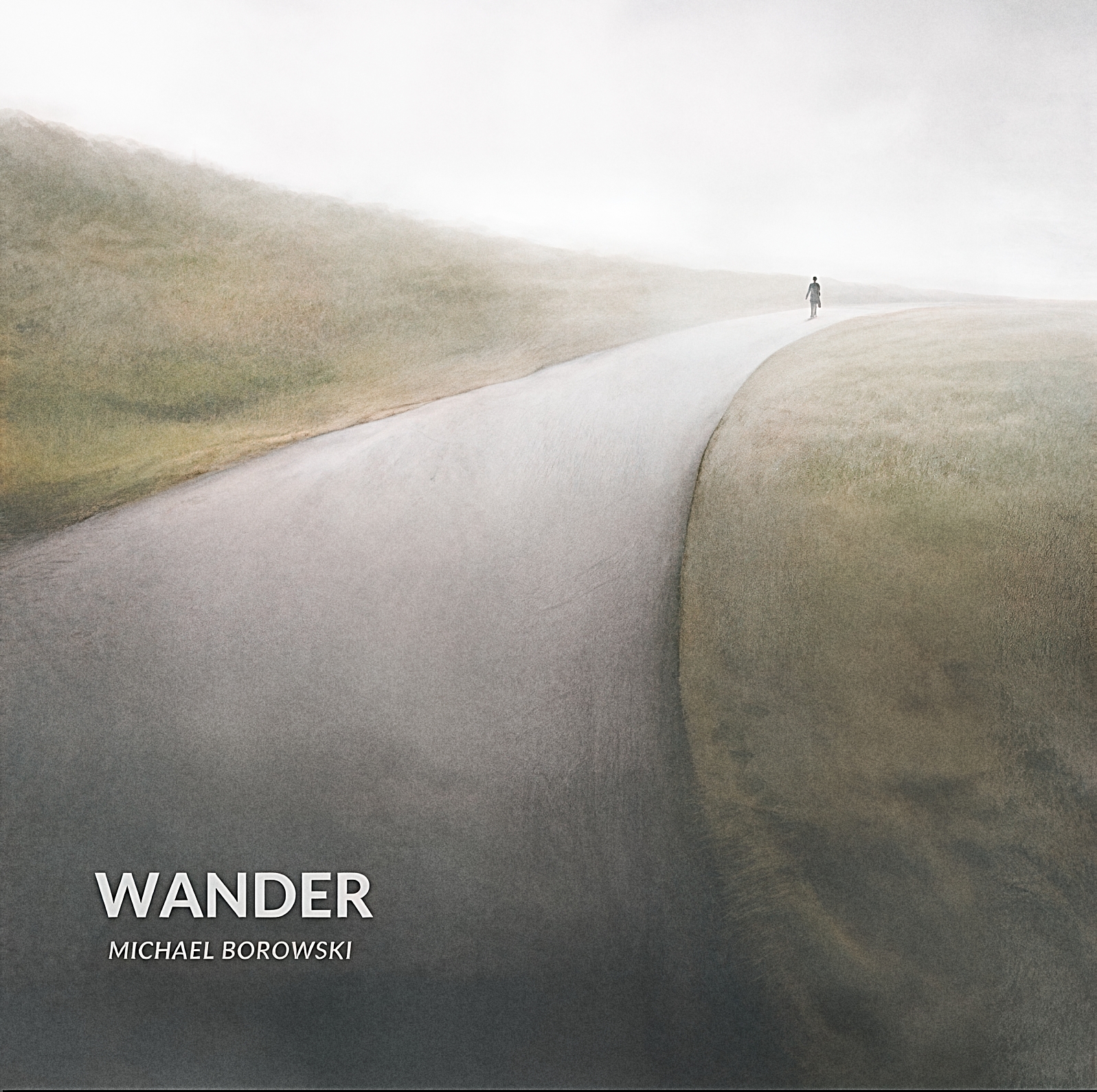
Released in 2025, Wander is, in some ways, the most revealing title in Borowski’s catalogue.
It is also his most concise statement. Six tracks. Twenty-three minutes. Bella’s Chime, Pale Blue Dot, I’ll Back You Up, The Wanderer, The Day You Came and In Motion.
The sequence feels almost cinematic. “Bella’s Chime” establishes an intimate opening. “Pale Blue Dot” expands the horizon. “I’ll Back You Up” brings warmth and human connection. “The Wanderer” turns the gaze inward again. “The Day You Came” returns to memory and arrival, before “In Motion” closes the journey.
The title track is not a conclusion. It is an invitation to continue. There is something particularly attractive about Wander because Borowski does not suddenly abandon what came before. The emotional intimacy of Peace Valley is still there. The landscapes of Gardens of Zion in the Rain are still there. The contemplative darkness of Unlit Moon and the openness of Acceptance have not disappeared.
They have simply become part of a larger vocabulary. This is evolution not through reinvention, but through accumulation.
A piano that refuses to stand still
The most interesting development in Borowski’s recent work may therefore be less about harmony, technique or production than about freedom. His music increasingly feels comfortable with movement.
That is particularly evident in “In Motion”, released as a single and also closing Wander. The title almost functions as a manifesto. Borowski’s music is in motion because the pianist himself remains in motion — between composition and improvisation, solitude and collaboration, memory and the present moment, intimate piano rooms and the larger stages he hopes to reach.
His experience performing with other musicians has also shaped this sensibility. Borowski has described his solo work and his life with bands as two necessary sides of the same musical personality. One gives him intimacy; the other gives him rhythm, energy and collective exchange.
The piano may be alone on stage. The musical imagination is not.
The art of leaving space
Perhaps the most contemporary aspect of Borowski’s music is also the simplest: he leaves room.
Room for silence.
Room for memory.
Room for the listener.
Instrumental music can easily become overly descriptive. Give a piece a title, attach an image, add a biography, and suddenly the listener is being told what to see. Borowski tends to do the opposite. He offers a suggestion.
A place without coordinates. A memory without a complete explanation.
A melody that can belong to the composer for one moment and to the listener the next.
It is why the landscapes suggested by his music do not have to be his landscapes.
They can become ours.
From Peace Valley to Paris
Seen as a whole, Michael Borowski’s catalogue tells a quietly compelling story.
Peace Valley looked inward.
Gardens of Zion in the Rain transformed memory into landscape.
Unlit Moon explored the spaces where emotions remain partly unspoken.
Acceptance opened the door toward release.
And Wander began to move.
That movement now has a geographical dimension as well.
Borowski is preparing to bring his music to Paris through Piano Revenge, a city he has long dreamed of performing in. In our recent interview, he spoke about the importance of international performance and his hope that new encounters might open further doors for his music.
It feels fitting.
A pianist whose music has always been concerned with places, journeys and inner landscapes is now taking the piano somewhere new. But perhaps the most beautiful thing about Borowski’s evolution is that he does not appear to be chasing a destination.
He is following the music.
And the music, for now, is in motion.
Michael Borowski’s journey from Peace Valley to Wander is not a straight line. It is a landscape — one that keeps changing every time he sits down at the piano.