Vital Varkovic — Rooms and Flowers: The Quiet Architecture of Memory
Beauty does not necessarily resolve uncertainty, but it can change the way we experience it.
There is a particular kind of intimacy in solo piano music that does not ask to be noticed. It unfolds quietly, allowing space for thought, memory and the small emotional shifts that often escape the pace of everyday life. With Rooms and Flowers, Polish pianist and composer Vital Varkovic brings together thirteen original solo-piano compositions in an album that explores this understated territory.
The title suggests two contrasting yet complementary images. A room is a space we inhabit, a place that can offer shelter, solitude or the possibility of retreat. A flower, by contrast, evokes something living and transient: a presence that develops in its own time, often without drawing attention to itself. Together, these images offer a compelling point of entry into Varkovic’s musical world, where inward reflection and the passage of time become natural companions.
The album brings together eleven previously released singles and two new compositions, placing familiar material within a broader context. This approach changes the way individual pieces can be heard. A composition encountered on its own carries its own beginning and end; within an album, it becomes part of a larger narrative, shaped by what precedes it and what follows. Rooms and Flowers invites precisely this kind of listening, allowing its individual pieces to contribute to a more comprehensive artistic statement.
Its thirteen titles suggest a sequence of shifting perspectives. First Floor establishes an architectural point of departure, while Steps in Reflection and Maybe Tomorrow introduce ideas of movement, contemplation and possibility. Elsewhere, titles such as minutes ago, more or less and Like Any Other Day draw attention to the ordinary passage of time. These are not grand declarations. They point instead towards the quiet significance of moments that might otherwise pass unnoticed.
The album’s emotional vocabulary continues to develop through Drive, In Need of Light and Lights, before arriving at the disarmingly direct i think you need a flower. The latter introduces a different kind of intimacy: less concerned with explaining an emotion than with offering a simple gesture of care. In the context of the album’s title, the image feels especially pertinent. Beauty does not necessarily resolve uncertainty, but it can change the way we experience it.
Later, No Reason to Move, Silent Bloom and Carousel suggest different relationships with stillness and motion. The contrast between remaining in place and moving in circles is particularly evocative, opening up questions about the ways we revisit familiar thoughts, return to earlier experiences and recognise changes that have occurred almost imperceptibly. The closing track, Fade, provides a fitting final title for an album concerned with transience. What fades is not necessarily lost; sometimes, it simply becomes part of the background against which we understand the present.
Varkovic’s choice to bring thirteen original compositions together under one title also gives the project a sense of completion. The album has been described as the closing of a musical chapter, a framing that lends additional significance to its release. Rather than treating the collection merely as an inventory of individual works, it can be approached as a moment of reflection on a body of music and the period of artistic development it represents.
There is value in this kind of conclusion. Contemporary piano music often exists in a continuous stream of singles, each released into an increasingly crowded listening environment. An album offers a different proposition: the opportunity to step back, establish connections and hear a musical identity emerge across a longer span. Rooms and Flowers makes that proposition central to its form.
Ultimately, the album’s appeal lies in the relationship between its modest imagery and its larger sense of purpose. Rooms, flowers, light and passing moments are familiar elements of everyday life, yet they can become meaningful when considered with sufficient attention. Varkovic’s project invites the listener to slow down and reconsider these ordinary experiences, not as material requiring grand interpretation, but as a part of life worthy of being heard.
With Rooms and Flowers, Vital Varkovic marks the close of one chapter while leaving space for whatever follows. Its thirteen compositions form a gathering of musical moments that, taken together, encourage a quieter kind of attention — one in which the smallest details may ultimately prove the most enduring.
The Artwork — A Doorway into Memory
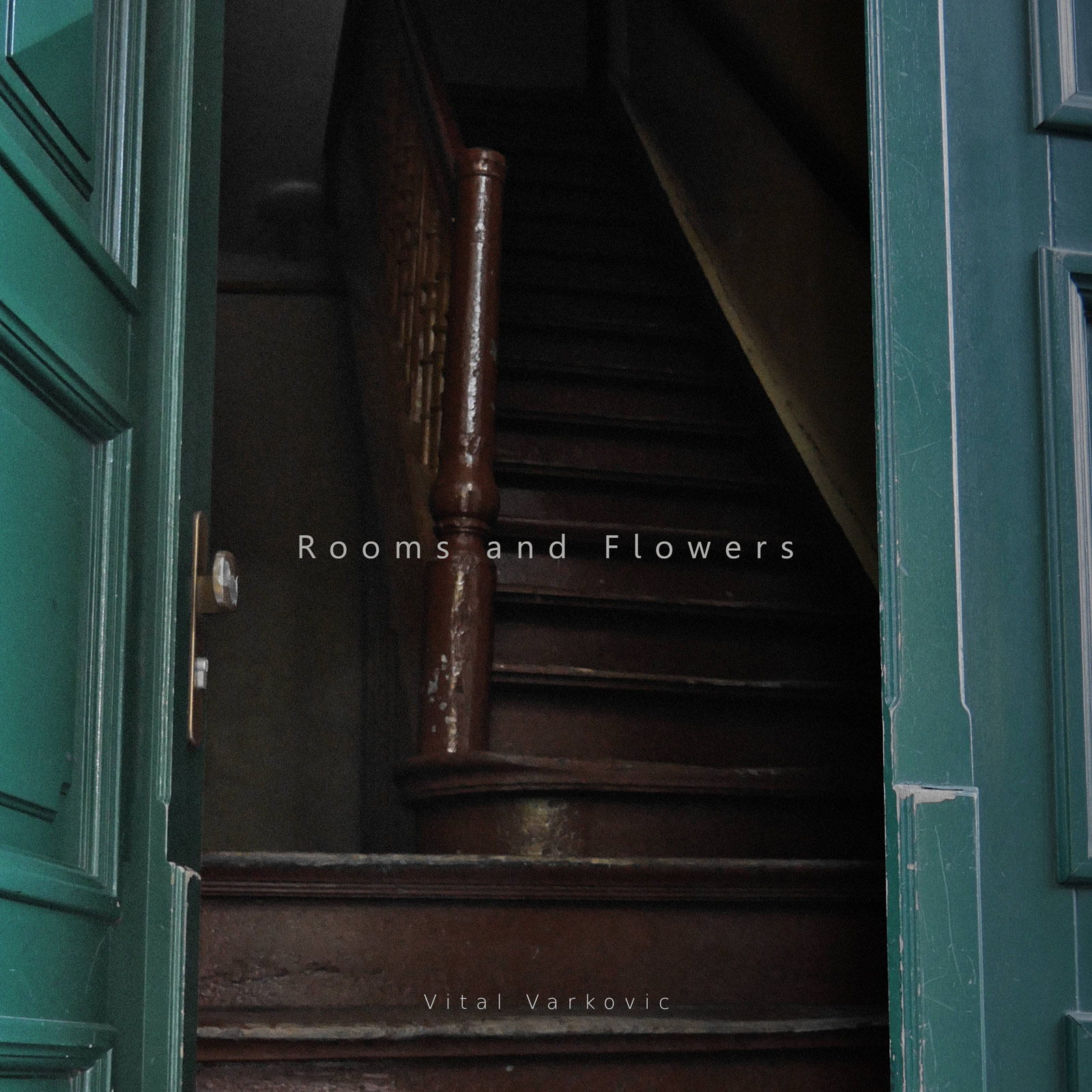
The cover of Rooms and Flowers offers a visual counterpart to the album’s minimalist piano aesthetic. An old wooden staircase disappears into darkness, framed by weathered teal-green doors. Chipped paint and worn timber suggest a place shaped by time, while the space beyond the threshold remains hidden.
The title invites a reading of two contrasting ideas. Rooms may suggest private interiors — places where memories accumulate and personal experiences leave their traces. Flowers, by contrast, evoke life, fragility and renewal. Together, they create a subtle tension between what remains and what continues to grow. The cover reinforces this interpretation: although no flowers are visible, the aged architecture suggests a world in which the past is still present, and change remains possible.
The restrained typography allows the staircase to remain central, with the contrast between cool green and deep brown establishing the mood. Before a single note is heard, the artwork invites the listener into an intimate, slightly enigmatic world where memory and renewal coexist.
Editor’s Note — A Musical Journey Across Borders
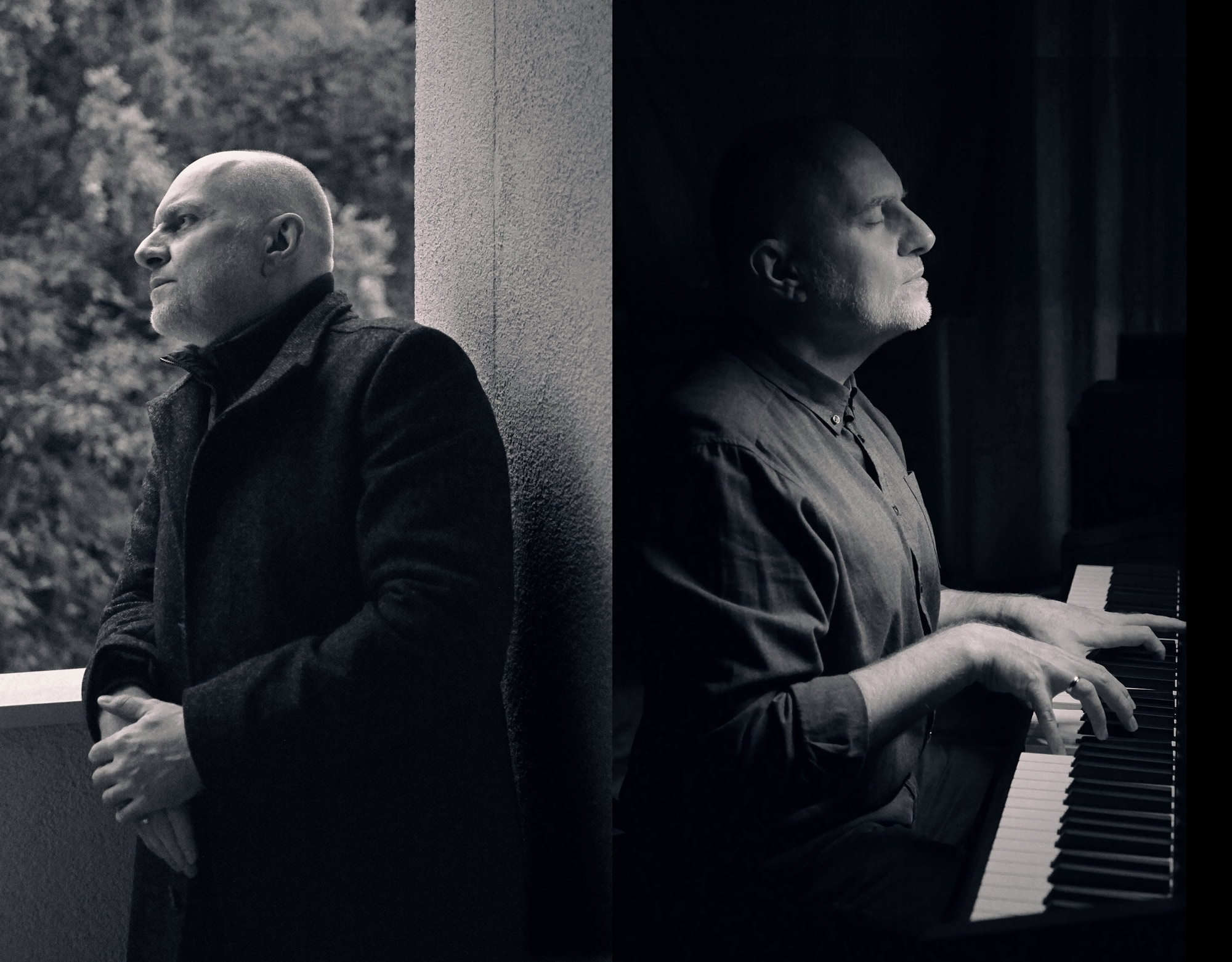
Vital Varkovic’s musical path has crossed borders, genres and artistic disciplines. His early musical education began in Lithuania, where he studied piano and accordion and performed with an accordion orchestra, travelling and giving concerts in several European countries. After moving to Poland, he continued his musical development through conducting studies and piano performance in a jazz band, before taking an unexpected turn as a vocalist in a rock band.
Today, Varkovic focuses on composing solo piano, ambient and meditative music, seeking to create sound worlds that offer calm, warmth and a sense of inner balance. His artistic influences span different generations and aesthetics, from Frédéric Chopin, Claude Debussy and Erik Satie to Zbigniew Preisner, Ludovico Einaudi and Joep Beving.
This diverse background provides an interesting context for Rooms and Flowers. Behind its quiet, minimalist character lies a musical journey shaped by different traditions, performance experiences and stylistic encounters — a reminder that simplicity in music can emerge not from a lack of experience, but from a long process of artistic discovery.