Ed Bazel: RÊVERIE – When the Piano Dreams in Orchestral Colour
There are albums that invite us to listen, and there are albums that invite us to feel. Ed Bazel’s RÊVERIE belongs firmly to the latter category.
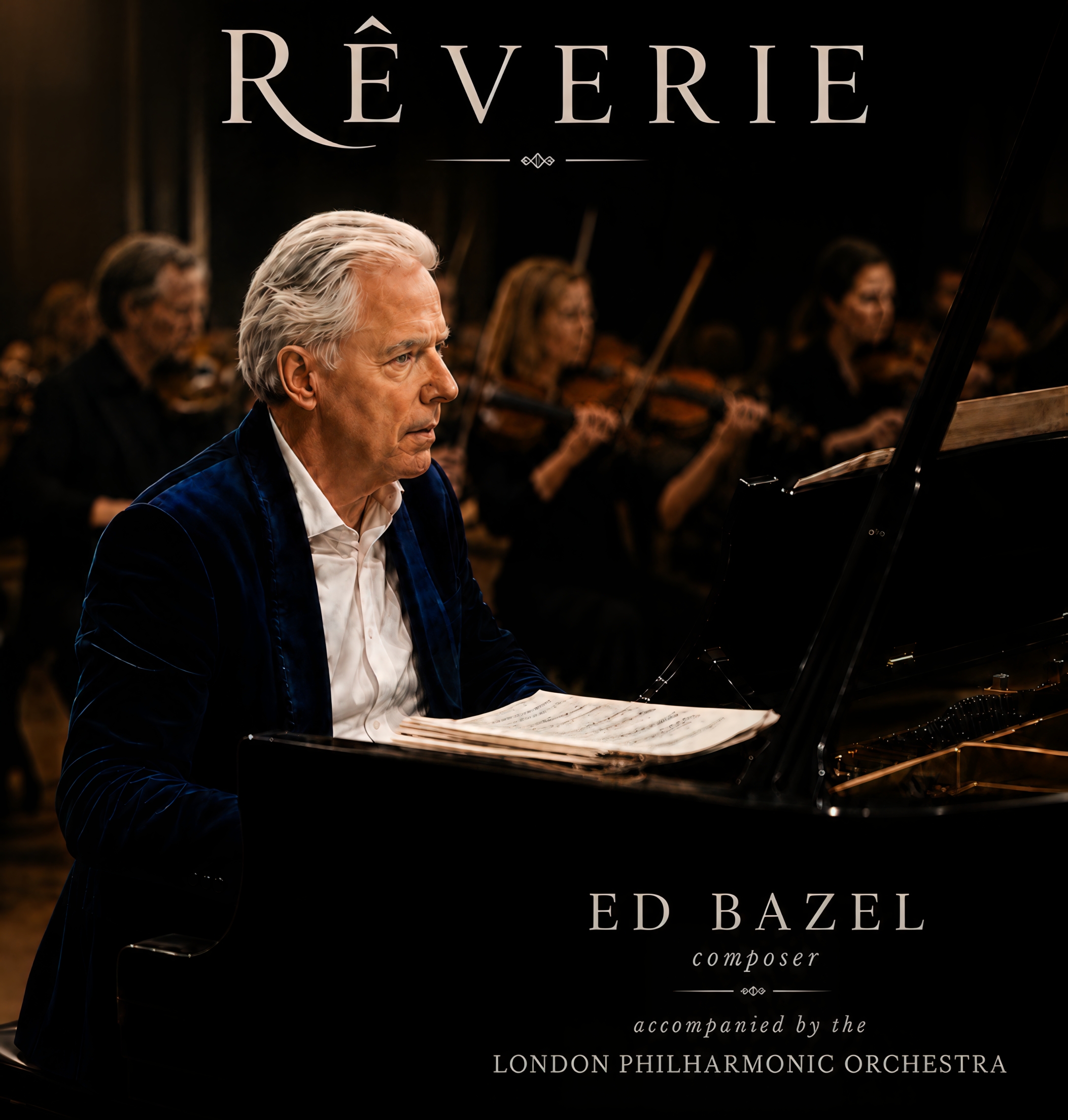
Created for piano and orchestra, RÊVERIE brings together Bazel’s gift for melody with the expansive colours of the London Philharmonic Orchestra, conducted by GRAMMY® winner, Michael Repper. Recorded at the legendary Abbey Road Studios, the album feels both intimate and cinematic: music born from the piano, but given an entirely new horizon through orchestral sound.
At the heart of Bazel’s musical language is something deceptively simple: melody. He does not treat melody as a decorative element, but as the emotional centre of the composition. His piano writing is direct, lyrical and deeply human, allowing a phrase to linger long enough for the listener to attach a memory, an image or perhaps simply a feeling to it.
With RÊVERIE, however, that familiar intimacy is surrounded by a much larger world.
The opening impression is one of cinematic breadth. The piano remains the emotional narrator, while the orchestra seems to illuminate everything surrounding it – sometimes like a landscape appearing beyond a window, sometimes like a memory gradually coming into focus. Rather than competing with the piano, the orchestral writing expands its emotional vocabulary.
This is particularly effective because Bazel’s music has always possessed a strong visual quality. His compositions seem to suggest places and states of mind without requiring a literal narrative. Titles such as “Soaring,” “Daybreak,” “Romance in the Redwoods,” “Moonlight Over Muir Woods,” “The London Waltz,” “The Tide,” and “Autumn Reverie” already hint at this relationship between music and imagery.
The result is an album that can be experienced almost like a sequence of paintings.
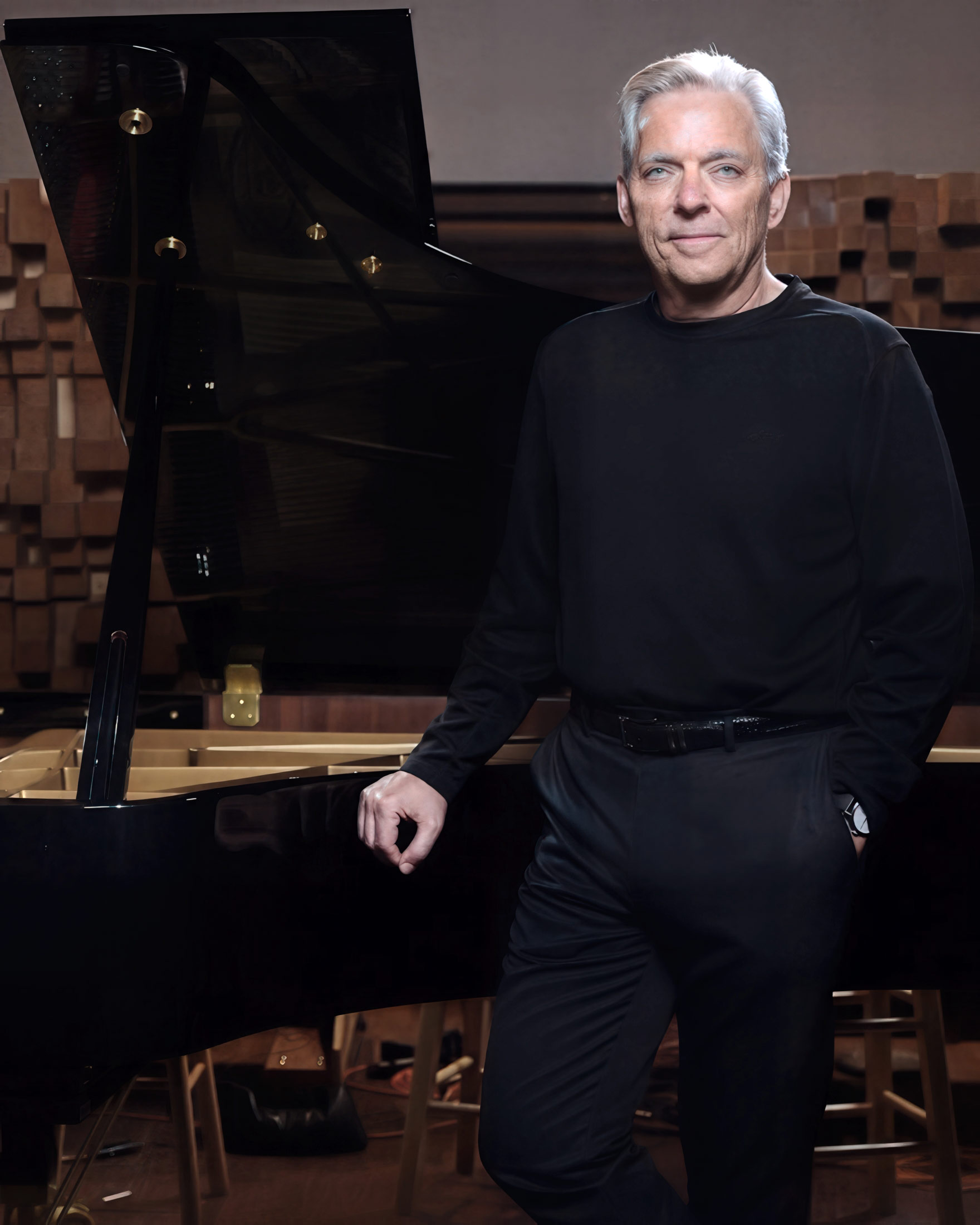
The piano, still warm at the centre
What makes RÊVERIE especially compelling is that the orchestral scale never completely obscures the pianist.
Bazel’s playing retains its characteristic warmth. There is a certain generosity in his touch – an unwillingness to rush through a beautiful phrase simply because the music has somewhere else to go. His piano often feels conversational rather than demonstrative. Even when the orchestra rises around him, the music remains personal.
That quality is important.
In contemporary instrumental music, there is always a temptation to make a piece sound “bigger” by adding layers. RÊVERIE demonstrates that orchestral grandeur works best when it serves the emotional core of the composition. Here, the orchestra becomes an extension of the piano’s imagination.
The arrangements by On Staff Music, David Fogel and Kitt Wakeley are therefore central to the album’s character. They create space around Bazel’s melodies, adding movement, depth and colour while preserving their essential simplicity.
Scenes in soft focus: from Daybreak to The Tide
Several pieces illustrate particularly well Bazel’s ability to transform an apparently simple melodic idea into an expansive emotional scene.
“Daybreak” carries the sensation of emergence – of light arriving gradually rather than dramatically. The piece feels less like a musical declaration than a quiet opening of the curtains. The piano establishes the intimacy, while the orchestra gives that first light an almost panoramic dimension.
Elsewhere, “Soaring” naturally suggests one of the album’s most expansive emotional gestures. There is something liberating in the title itself, and Bazel’s music responds with an upward-moving sense of possibility. It is music that seems to look beyond the immediate moment.
Then there is “Moonlight Over Muir Woods,” where the cinematic potential of the orchestral setting becomes particularly evocative. Bazel’s connection with landscape has been an important part of his recent musical identity, and this piece transforms that connection into something almost dreamlike.
“Romance in the Redwoods” carries another kind of intimacy. Rather than presenting nature as something monumental, Bazel allows it to become personal – a place associated with tenderness, memory and quiet wonder. His recent work has repeatedly demonstrated this ability to translate landscape into emotion, and the piece feels like a natural continuation of that artistic voice. His earlier album A Weekend in Marin, for example, similarly drew inspiration from Northern California landscapes and the atmosphere of Marin County.
And when The Tide arrives, the album seems to find one of its most elemental metaphors. The movement of the sea is an ideal parallel for Bazel’s musical language: repetition without stagnation, return without exact repetition, motion that is simultaneously calming and inevitable.
Abbey Road, and the art of making space
There is also a fascinating historical dimension to RÊVERIE.
For Bazel, recording at Abbey Road Studios is not simply a prestigious location. The studio has been part of his artistic journey before, particularly through The London Sessions, and his lifelong admiration for The Beatles gives the space a personal significance.
But RÊVERIE adds another dimension to that story: Bazel’s music is now being placed in dialogue with a major symphonic ensemble.
The recording of the album with the London Philharmonic Orchestra becomes, in this sense, more than a production achievement. It represents an evolution in scale. The intimate piano composer who has built his language around melody, memory and emotional warmth is now allowing those melodies to inhabit a much larger acoustic world.
And remarkably, they survive that expansion intact.
Music Without Distance
Perhaps the most appealing quality of RÊVERIE is its lack of pretension.
Bazel is not trying to overwhelm the listener with complexity. His ambition is different: to create music capable of carrying emotion clearly and sincerely.
That sincerity has been a constant in his work. Earlier recordings such as Homecoming and The London Sessions were praised for their melodic warmth, elegance and ability to create a sense of comfort without sacrificing musical craft.
RÊVERIE takes those qualities and places them beneath a wider sky.
The orchestra adds grandeur, but the heart of the music remains remarkably close to the listener.
That is perhaps the album’s greatest achievement.
In an increasingly noisy musical world, RÊVERIE chooses another path:
beauty without excess, emotion without theatricality, and orchestral grandeur without losing intimacy.
It is music for moments when we want to step outside the urgency of everyday life – to look through a window, remember somewhere we have been, imagine somewhere we might go, or simply allow a melody to accompany our thoughts.
And perhaps that is exactly what the title promises.
A rêverie is a daydream – a state between waking and dreaming, where the imagination is free to wander.
Ed Bazel’s RÊVERIE gives that wandering a soundtrack.
A graceful, cinematic and deeply melodic album – and a beautiful new chapter in Bazel’s continuing journey between piano, memory and orchestral colour.
A closing note, like a Paris evening
The finest thing about RÊVERIE is how closely it speaks. Nothing is overstated; nothing begs to impress. Bazel lets melody do what it has always done best-carry feeling with a clean hand and an unhurried pulse, as if the piano were telling you a secret across a small table.
In a world that often confuses volume with meaning, this album chooses a more elegant persuasion: beauty without excess, emotion without theatricality, and orchestral light that never steals the piano’s warmth. It’s music for late hours – when the city grows softer, the air smells faintly of rain, and you find yourself listening the way you might watch streetlights blur along the Seine.
Album details: RÊVERIE is composed and performed by Ed Bazel for piano and orchestra with the London Philharmonic Orchestra, conducted by Michael Repper, with orchestral arrangements by On Staff Music, David Fogel and Kitt Wakeley, recorded at Abbey Road Studios.
Listen to RÊVERIE on Spotify: Ed Bazel – RÊVERIE
● Piano & compositions: Ed Bazel
● Orchestra: London Philharmonic Orchestra
● Conductor: Michael Repper
● Recorded at: Abbey Road Studios
● Orchestral arrangements: On Staff Music, David Fogel & Kitt Wakeley
Editor’s Final Note
There is something quietly thrilling about an artist who stays faithful to the simple power of melody – then dares to let it wander into a larger room.
With RÊVERIE, Ed Bazel keeps the piano as his most intimate voice, while the London Philharmonic Orchestra brings a halo of colour around it – cinematic, yes, but always tender, always human-sized.
For Piano Revenge MAG, this is the kind of record we return to for its rare clarity: music that communicates without barriers. RÊVERIE doesn’t ask the listener to decode it. It simply invites you to enter, to listen, to remember – and, for a few minutes, to live a little more slowly.
Congratulations to Ed Bazel and the remarkable team behind this beautiful project. From the first piano phrase to the last orchestral breath, RÊVERIE feels like a small recital held at dusk – candles low, the world outside softened, and wonder left within reach.
And sometimes, that is exactly what music is meant to do.
—
Anna Bondareva
Editor, Piano Revenge MAG
Founder & Artistic Director, Piano Revenge Festival