Between Roots and Horizons: Tetiana Viktory – PianoRevenge Mag
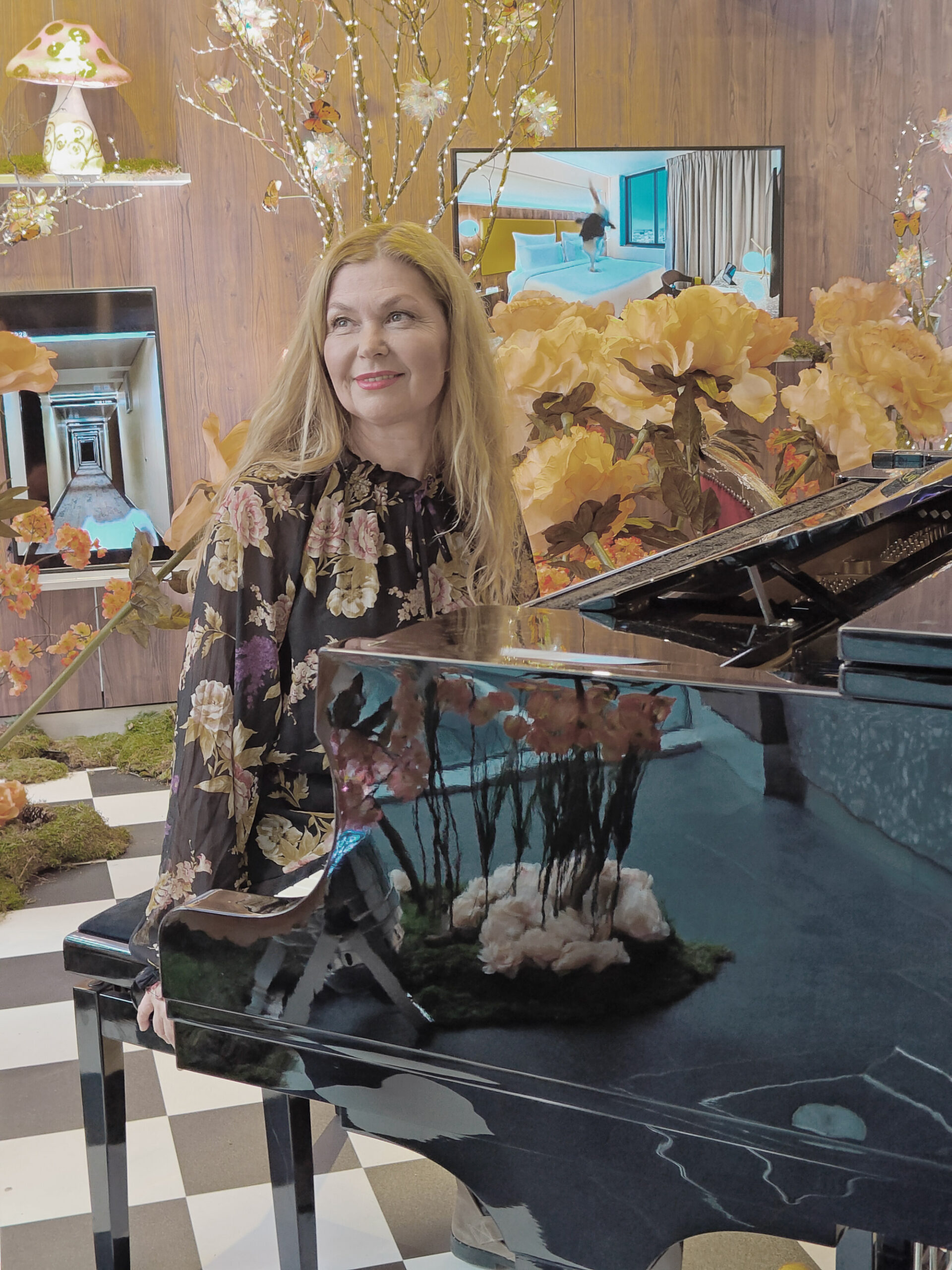
From Ukrainian musical traditions to the creative freedom she discovered in France, pianist, composer and musicologist Tetiana Viktory has built an artistic world where classical repertoire, original composition and cultural memory meet. In this conversation with Piano Revenge MAG, she speaks about her journey from more than two decades of teaching in a major music academy to a new creative chapter in France, the origins of her project Le Pont, her fascination with classical crossover, the power of collaboration, and the hope at the heart of her newest music.
There are moments when a change of place becomes much more than a change of address. For Tetiana Viktory, moving to France in 2022, during a period of war, became a profound turning point – personally, professionally and artistically. After more than twenty years of teaching at a major music academy, she entered a new environment in which uncertainty and necessity unexpectedly opened a space for creative freedom.
Today, the piano is for me a space in which I can transform personal experience into music.
Her first original composition, Mouette, arrived almost like a message from another world: its melody came to her in a dream. From there, a new artistic path began to unfold, one increasingly shaped by the dialogue between Ukrainian musical roots and the European classical tradition.
At the centre of this journey stands the piano – not simply as an instrument, but as a space in which memory, colour, movement and personal experience can be transformed into sound. Her project Le Pont embodies this philosophy, connecting Ukrainian intonational and semantic roots with works from the European classical tradition.
In this interview, Tetiana Viktory takes us inside that world.
A New Country, A New Creative Freedom
PRM: Your journey is remarkable: more than 20 years of teaching at a major music academy, followed by a new chapter in France from 2022. How did this change of environment transform your creative approach and your relationship with the instrument?
Tetiana Viktory: The change of country during a period of war profoundly transformed my life and my creativity. In France, I had to adapt, look for work and rebuild my everyday life. But paradoxically, in the middle of all these constraints, I experienced a profound sense of inner freedom, as if a new creative space had opened within me.
That is how Mouette, my first original composition, was born. Its melody came to me in a dream.
Paris and France have become a major source of inspiration for me: concerts, museums, especially exhibitions of painting and the dialogue between music and visual art at places such as Atelier des Lumières, as well as new artistic collaborations. All of this has transformed my perception of sound, colour and space, and my relationship with the piano has become freer and more personal.
Little by little, the project Le Pont began to take shape. Through it, I reveal the intonational and semantic roots of Ukrainian music by bringing them into association with works from the European classical tradition.
Building Bridges Between Musical Worlds
PRM: You combine traditional melodies with European influences in your original compositions. How do you fi nd the balance between being rooted in a musical tradition and exploring new sonic languages?
Tetiana Viktory: For me, everything begins with the idea behind the work.
Take Cosaque de Beethoven, for example. I wanted to create music carried by a heroic and highly intense energy. I brought together the powerful finale of a Beethoven trio with the Ukrainian song The Cossack Was Riding Beyond the Danube. Then I discovered something almost symbolic: Beethoven himself knew this melody and had created his own arrangement of it, Schöne Minka, ich muss scheiden, WoO 158 No. 16.
So two musical worlds that initially seemed distant already had a shared history. This is precisely why I love the genre of classical crossover. It allows very different musics to coexist and enter into dialogue.This is often how I construct my music. I think of collage in painting: elements from different periods, cultures or styles are brought together and suddenly a new narrative appears.
My goal is to preserve the emotion and identity of each element while giving them new life through a personal and contemporary language.
An Album as an Inner Journey
PRM: Your album, which you began in 2022, brings together Beethoven, Bach, Piazzolla and your own compositions. What connects these seemingly different musical universes?
Tetiana Viktory: If each piece is, for me, a kind of musical collage, then the album as a whole needed to possess a deeper unity. What connects Beethoven, Bach, Piazzolla and my own compositions is not their period or their style, but the emotional energy that I want to carry from one work to another. I did not want to construct a programme based on historical chronology. I wanted to create a journey.Some works carry tension, others light, nostalgia or a powerful impulse. My own compositions enter this journey as bridges between these different worlds.
So the album’s connecting thread is less a particular style than an inner dramaturgy.
The Magic of Musical Dialogue
PRM: You have collaborated with 11 soloists from Europe, the United States and Turkey. Is there one collaboration that has particularly transformed your understanding of chamber music?
Tetiana Viktory: It is difficult for me to distinguish one partner among all those with whom I have had the opportunity to perform. Each musician has a unique personality, and I am deeply grateful for every shared experience.
Through these encounters, I have been able to discover and perform wonderful works, including Ravel’s Trio, the cello and piano sonatas of Martinů, and many others. But if I had to identify the true “protagonist” of all these collaborations, it would be the magic of musical dialogue. That moment when several musicians breathe together, listen to one another, respond and create something that did not exist a few seconds before – that continues to fascinate me. Perhaps this is what touches me most about chamber music: every performance becomes a human encounter as much as a musical one.
Listening Until Two Voices Become One
PRM: Your 2005 recording with violinist Irina Olchanska – featuring Messiaen, Poulenc and Skoryk – remains an important milestone. What did this encounter mean for you as an interpreter?
Tetiana Viktory: This meeting was very important in my development because it strengthened my understanding of chamber music as a genuine dialogue.
With Irina, we worked on three very different musical worlds – Messiaen, Poulenc and Skoryk – each requiring its own colour, listening and way of breathing.
Recording the album taught me to seek not only precision, but above all a shared sonic identity: a space in which two performers almost cease to feel separate.
This experience profoundly influenced the way I later approached chamber repertoire. For me, playing with a partner means first of all listening, reacting and constructing a shared musical vision.
Between the Orchestral Piano and Silence
PRM: As both pianist and composer, which composers or performers have most influenced your personal musical language? Is there a work that changed your life?
Tetiana Viktory: I would say that a major stage in my career was my encounter with the First Piano Concerto by the Ukrainian composer Oleksandr Kanerstein. I performed it with the National Radio Orchestra of Ukraine under the direction of Vyacheslav Blinov, and we subsequently made a recording that entered the archives of Ukrainian Radio and Television. It is a very particular work. The piano part possesses such density and richness of texture that I often feel it is almost a concerto for two orchestras – the symphonic orchestra and the piano itself.
This experience profoundly influenced the way I think about the piano: its power, its colours and its orchestral possibilities.
At the opposite extreme, I am deeply attracted to more sparse and introspective musical worlds: Satie, Poulenc, Silvestrov, as well as Arvo Pärt and Philip Glass.
I love their ability to create an extremely powerful emotion with very few means – sometimes with only a few notes, a silence or an unexpected harmony.
I believe my own musical language has developed somewhere between these two poles: the almost orchestral richness of the piano and the search for simplicity, space and emotion.
But every artist evolves.
Today I am particularly inspired by classical crossover, a genre in which I am increasingly working. It allows me to expand the horizons of the academic tradition, bring very different styles into dialogue and, above all, create new paths through which a wider audience can discover classical music.
When Music Opens an Inner World
PRM: Since arriving in France, you have organised numerous concerts and participated in festivals. How has French audiences responded to your music, and which reactions have touched you most deeply?
Tetiana Viktory: French audiences have welcomed my music with great warmth and kindness.
I feel a genuine sense of listening, curiosity and support, and this gives me the desire to continue creating and developing my musical world.
My project Le Pont, built around a dialogue between Ukrainian and European musical material, has an important place in this encounter with audiences. I have already presented it in several concerts and festivals, and I have been deeply touched by the way French audiences perceive this idea of dialogue between different musical traditions.
One of the testimonies that touched me most came after a private concert.
A woman told me that while I was playing, she felt as though she had entered “a parallel world.” She became so immersed in the music and relaxed that a solution to a difficult situation that had been troubling her for a long time suddenly came to her.
This kind of response is extraordinarily precious to me. When music does not simply produce an emotion, but opens an inner space in which something can transform, I feel very strongly the meaning of what I do.
The Precision of Freedom
PRM: One critic described your playing as “surgical and so organic.” How do you maintain the balance between technical precision and raw emotion?
Tetiana Viktory: I believe technical precision only has meaning when it serves expression.
For me, technique is a form of freedom. The more it is mastered, the more I can forget the physical gesture and concentrate on colour, breathing, the tension of a phrase and the emotion it carries.
At the same time, I always try to preserve something alive and spontaneous.
I do not like the idea of a fixed interpretation. Even in a work I have performed dozens of times, I try to remain attentive to what is happening in the moment – to the acoustics, the silence, my own sensations and the energy of the audience.
Perhaps this is where the balance between the “surgical” and the “organic” lies: a very precise construction, but one sufficiently free for the music to breathe and remain human.
When Scholarship Meets Sound
PRM: Your musicological thesis, defended in 2020, explored the artistic image of the
perpetuum mobile. How does academic research continue to influence you as a performer and composer?
Tetiana Viktory: Academic research taught me above all to look at music within a much broader context, in connection with art history, aesthetic ideas and other forms of artistic expression.
My thesis focused on the artistic image of the perpetuum mobile in European music of the nineteenth century and the first half of the twentieth century. I studied the phenomenon not only in music, but also across different artistic fields, looking for correspondences between movement, rhythm, repetition, energy and the perception of time.
This approach continues to influence the way I interpret and compose. It helps me hear a work not simply as a succession of notes, but as a system of images, symbols, tensions and associations.
For me, musicological reflection and artistic practice are therefore not separate. They constantly nourish one another.
The Breath of the Human Voice
PRM: You have also collaborated with soprano Iryna Vezhnovets and mezzo-soprano Olha Tabulina on your 2019 album. What does working with singers reveal about your own relationship with melody and musical breath?
Tetiana Viktory: I would not really distinguish working with singers from working with other chamber-music partners. For me, it is always a dialogue between fully equal performers. Of course, the voice makes us particularly sensitive to breathing, the melodic line and the natural movement of a phrase. But the same principle exists in instrumental playing: listening to the other person, breathing together, sensing the direction of a phrase and constructing a shared interpretation.
It is this equality and quality of listening that interest me most in chamber music.
“My Best Work Is Yet to Come”
PRM: If you had to choose one work – from your repertoire or your own compositions – to represent who Tetiana Viktory is as an artist, which work would you choose, and why?
Tetiana Viktory: Perhaps I would answer with a touch of humour: my best work is yet to come.
But more seriously, I think that for every artist, the most important work is often the one they are working on in the present.
I have just completed Vive la rose, a solo piano composition inspired by the Neo-Romantic tradition.
This piece is particularly symbolic for me because it represents my second album, situated within the world of classical crossover.
And it carries an idea that is very dear to me: the hope that love and beauty can finally save the world.
A Bridge, Not a Border
Tetiana Viktory’s artistic journey is ultimately about connection.
Between Ukraine and Europe. Between tradition and reinvention. Between the written score and the living moment of performance. Between scholarship and intuition. Between the orchestral possibilities of the piano and the extraordinary emotional power of a few carefully chosen notes.
Her Le Pont project offers perhaps the clearest metaphor for her artistic philosophy: music does not need to erase differences in order to bring worlds together. It can preserve their identities while creating a space in which they can speak to one another.
And perhaps that is also the deeper meaning of her move to France. What began as a necessity became an opening – a new creative territory in which personal experience could be transformed into music.
Her newest work, Vive la rose, looks forward rather than backward. And with its message of hope, love and beauty, it seems to confirm what her final answer already suggests: the most important chapter may still be the one she is writing now.