Marcin Bela: Messages from the Night Sky
Four Archetypes, One Piano, and the Music of the Unseen.
There are piano recordings that begin with a composition, a score, or a clearly defined musical idea. And then there are recordings that begin somewhere less tangible – with an image, an intuition, a memory, a sensation that has not yet found words.
Due for release on September 10, 2026, Messages from the Night Sky by pianist and composer Marcin Bela belongs to the second category.
The project was born from an unusual encounter with an intuitive practitioner, who channeled messages that Marcin understood as coming from his ancestors and spirit guides. Four archetypal qualities emerged: the strength of a lion, the wisdom of a dragon, the grace of a swan, and the slyness of a crocodile. Rather than turning these ideas into literal musical portraits, Bela allows them to become starting points for a deeply personal piano language.
The result is a four-piece journey through four different states of being – Lion’s Nest, Dragon’s Cry, Swan’s Final Call, and Crocodile’s Tears – in which improvisation becomes something more than spontaneous invention. It becomes a method of listening.
This feels particularly significant knowing that Bela performed with us during the second Paris edition of Piano Revenge Festival this April.
On stage, we encountered the pianist as a performer; here, we encounter another side of the same artist – one willing to leave the security of redetermined musical architecture and follow instinct, atmosphere, and inner imagery.
For listeners discovering the project ahead of its September 10 release, Messages from the Night Sky offers not simply a collection of piano pieces, but an invitation into a personal and symbolic world where music, intuition and imagination meet.

The Lion: Lion’s Nest
The EP’s lion does not arrive as a stereotypical musical roar.
Instead, Lion’s Nest develops its strength gradually. The piece carries a grounded quality, with the piano’s lower and middle registers providing a sense of weight while the musical material slowly gathers intensity. There is a remarkable patience to its development. Rather than constantly searching for a climax, Bela allows phrases to accumulate and breathe.
The recording’s dynamic shape reinforces this impression. The music grows progressively more substantial before eventually retreating, creating the sensation of approaching something powerful without ever needing to announce its presence.
And perhaps that is precisely what makes the piece convincing as a musical interpretation of the lion.
True strength rarely needs to shout.
There is also something protective about the title Lion’s Nest. A nest is not a place of aggression; it is a place of shelter. The lion therefore becomes not simply a symbol of power, but of guardianship – strength placed in the service of something vulnerable.
The Dragon: Dragon’s Cry
If the other pieces were born through improvisation, Dragon’s Cry occupies a special position within the EP. Bela describes it as the only through-composed work, and that distinction is important.
The piece feels more architecturally defined, with a stronger sense of deliberate musical direction. Its harmonic language and melodic movement create a feeling of searching, tension and release, while the title suggests something much more complex than a conventional expression of sadness.
A dragon is traditionally associated with ancient knowledge, transformation and mystery. A “cry” from such a creature therefore feels less like an emotional outburst and more like an echo from somewhere beyond ordinary experience.
The recording has a particularly interesting rhythmic energy compared with the more spacious pieces elsewhere on the EP. Its underlying pulse gives the music forward movement, while the piano remains expressive rather than mechanically rhythmic. The result is a piece that feels like a journey through changing emotional landscapes.
Of the four archetypes, the dragon may be the most enigmatic – and Bela wisely does not attempt to explain it musically.
He lets it remain mysterious.
The Swan: Swan’s Final Call
Where Lion’s Nest is grounded and Dragon’s Cry carries a sense of transformation, Swan’s Final Call turns inward.
This is arguably the most immediately contemplative piece in the collection. Its slower pacing creates considerable space between musical gestures, allowing individual tones and harmonic colours to resonate beyond the moment in which they are played.
The title is important: this is not simply The Swan. It is the swan’s final call.
That word changes everything.
Beauty here is accompanied by impermanence. Grace is not presented as something static, but as something that exists precisely because it can disappear. The music’s gradual movement from greater intensity toward a quieter close reinforces this feeling, creating an almost cinematic sense of departure.
There is something deeply human in this piece.
It is not difficult to hear the swan as a symbol of farewell, acceptance, or the final moment before transformation. Yet the music never becomes melodramatic. Bela’s restraint is what gives it emotional power.
The piano seems less interested in telling us what to feel than in creating a space in which we can feel it ourselves.
Listen to single Swan’s last call (piano) on Spotify:
The Crocodile: Crocodile’s Tears
Perhaps the most intriguing archetype is the crocodile.
Strength and wisdom are relatively familiar spiritual symbols. Grace is equally easy to understand. But slyness – the quality attributed to the crocodile – introduces ambiguity.
Crocodile’s Tears responds to that ambiguity with a darker and more elusive musical character.
The piece develops through a stronger dynamic trajectory, becoming increasingly substantial before pulling away. There is a sense of movement beneath the surface, as though something is always happening that the listener cannot completely see.
And that is where the crocodile becomes an especially effective musical metaphor.
The crocodile waits.
It does not need constant movement to create tension. Its power comes from stillness, observation and timing. Bela’s improvisational approach allows exactly this kind of uncertainty to emerge. The music does not always reveal where it is going next, and that unpredictability becomes part of its character.
There is also a beautiful irony in the title. “Crocodile tears” traditionally suggest false emotion, yet within the spiritual framework of the EP, the animal is not reduced to deception. Instead,
Bela seems to explore the more complicated territory of instinct – the ability to remain hidden, to observe, to survive and to act at precisely the right moment.
When Improvisation Becomes Listening
Perhaps the most compelling aspect of Messages from the Night Sky is not any individual track, but the decision to make improvisation central to the project.
Improvisation is often described as spontaneous composition, but that description can be misleading. For an experienced pianist, improvisation can also be an act of listening – listening to the instrument, to silence, to the emotional direction of a phrase, and sometimes to something that is difficult to define.
Bela’s four archetypes provide him with four different emotional starting points.
The music does not attempt to imitate animals. There are no theatrical roars, wings, claws or obvious programmatic gestures. Instead, the animal becomes an inner quality.
The lion becomes strength. The dragon becomes ancient knowledge and transformation. The swan becomes grace and impermanence. The crocodile becomes instinct and ambiguity.
This is what prevents the EP from becoming merely a conceptual exercise. The concept is there, but it remains behind the music.

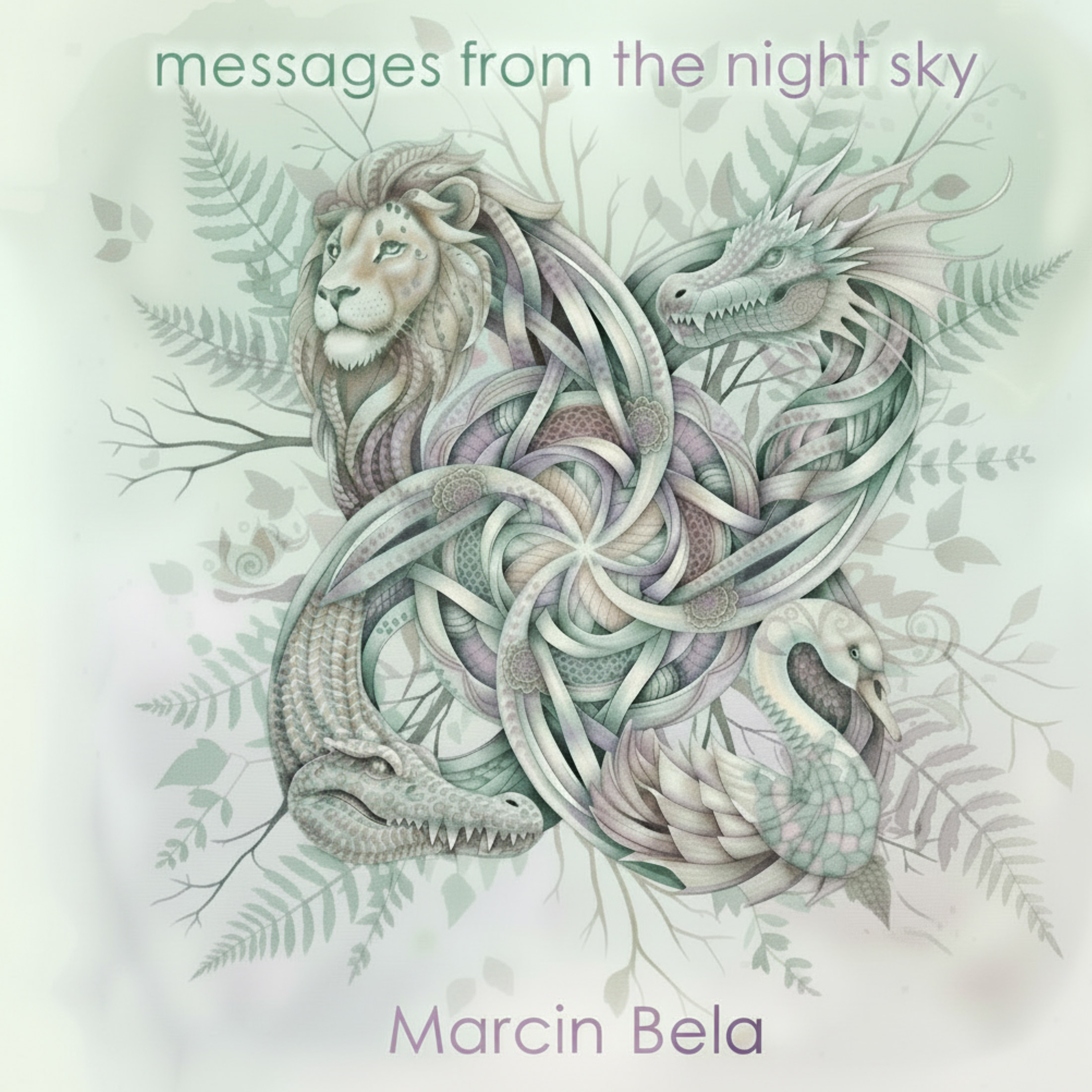
The Cover: Four Creatures, One Living Form
The cover artwork deserves particular attention because it communicates the philosophy of the EP almost immediately.
At first glance, we see four distinct creatures: the lion in the upper left, the dragon in the upper right, the crocodile in the lower left, and the swan in the lower right. Each occupies its own space and has its own visual personality.
But the longer one looks, the more apparent it becomes that these creatures are not actually separate.
Their bodies, tails, wings, scales and flowing forms intertwine around a central floral-like structure. The four animals become parts of one continuously connected organism.
That is a powerful visual interpretation of the EP.
The cover does not place the four archetypes in four isolated boxes. It suggests that strength, wisdom, grace and instinct coexist within the same individual. The lion does not exist without the crocodile; the dragon does not exist without the swan. They are different aspects of one larger psychological and spiritual landscape.
The muted palette of soft greens, pale greys, lavender and cream reinforces this idea. Nothing is aggressive or excessively dramatic. Even the dragon, traditionally depicted as a fiery creature, appears integrated into the same delicate natural environment as the swan and the lion.
The surrounding foliage is equally significant. Ferns, branches and leaves frame the animals, creating the impression that the four archetypes belong to an ancient natural world rather than a fantasy universe.
And at the centre, where the bodies intertwine, there is almost a mandala-like quality.
The image therefore works on several levels: it is an illustration of four animals, a representation of interconnectedness, and a visual metaphor for the structure of the music itself.
Even the lowercase typography of messages from the night sky contributes to the atmosphere. It feels intimate rather than declarative – as though these are not commandments written across the sky, but quiet messages received by someone willing to listen.
Four Messages, One Journey
Taken together, the four recordings form something more cohesive than a collection of piano improvisations.
They function as four stages of an internal journey.
The lion teaches us how to stand.
The dragon asks us to listen to ancient knowledge.
The swan reminds us of beauty and impermanence.
The crocodile teaches patience, instinct and the power of what remains hidden.
What makes the EP successful is that Bela never forces these interpretations upon the listener. The explanatory story provides a doorway, but the music allows each listener to walk through it differently.
This is especially effective in a piano context. A single instrument, without layers of orchestration or elaborate production, leaves considerable space for imagination. The silence between phrases becomes almost as important as the notes themselves.
And perhaps that is the ultimate meaning of Messages from the Night Sky.
The messages are not necessarily answers.
They are invitations to listen.

Final Thoughts
With Messages from the Night Sky, Marcin Bela has created an intimate and unusual EP that sits somewhere between neoclassical expression, spontaneous improvisation and spiritual reflection.
Its greatest strength is its restraint. Bela does not try to make the piano sound like a lion, a dragon, a swan or a crocodile. He searches instead for the qualities these creatures represent – and allows those qualities to shape the music from within.
The result is a work that feels personal without becoming inaccessible, spiritual without becoming overly literal, and improvised without feeling directionless.
After welcoming Marcin Bela to the Piano Revenge Festival stage in Paris this April, it is a pleasure to encounter this more inward chapter of his artistic voice. On stage, improvisation can be an immediate conversation with an audience. On Messages from the Night Sky, it becomes a conversation with something much less visible.
Four animals. Four states of consciousness. Four messages.
And one piano listening for what lies between the notes.