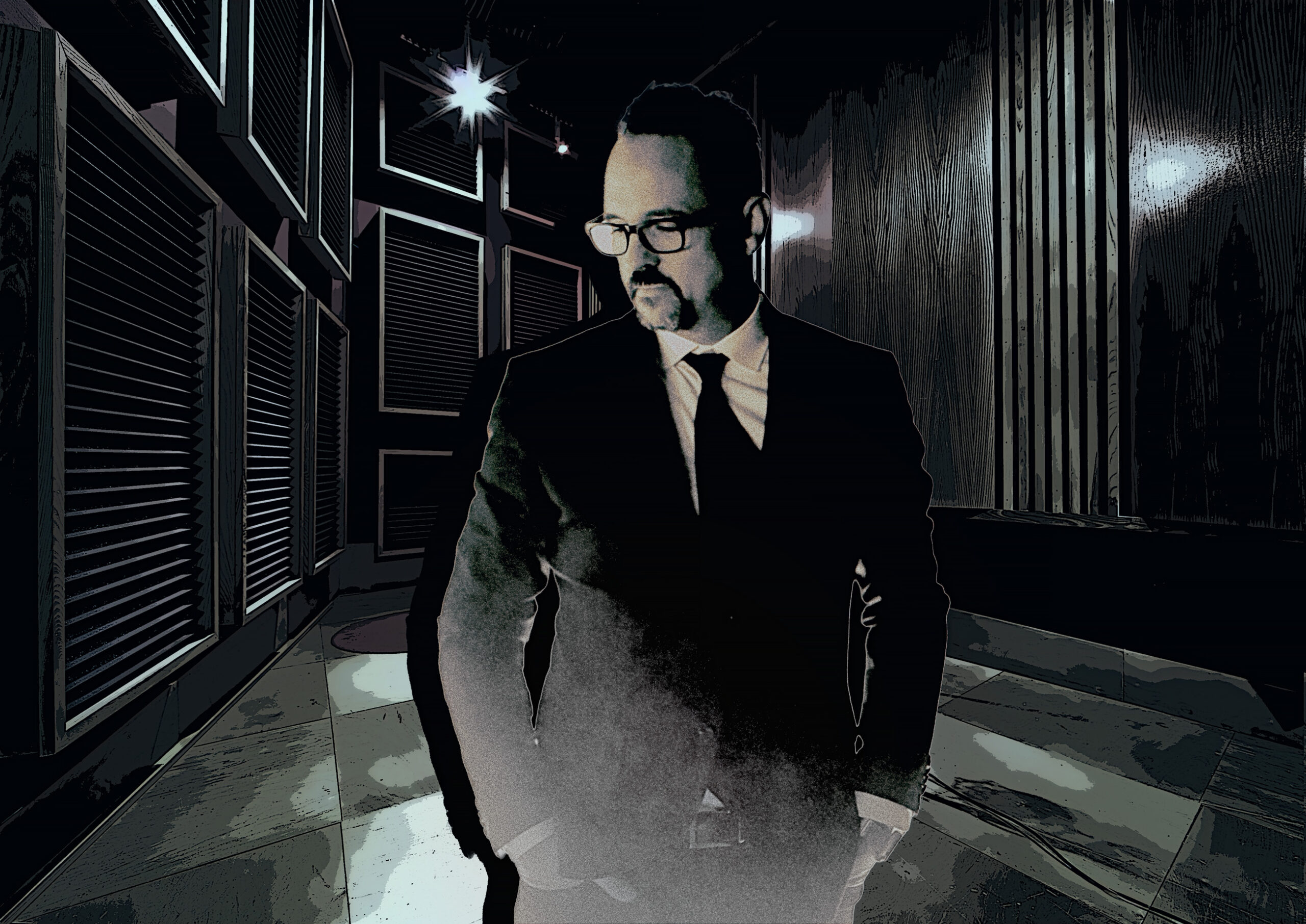
John Schroter: Full Circle – A Lifelong Conversation With the Piano
There are artists who approach the piano as an instrument.
And then there are artists for whom the piano becomes something much more intimate: a place to return to, a room without walls, a language that existed before they knew how to name it.
John Schroter belongs to the latter.
His relationship with the piano did not begin in a concert hall, nor with an ambition to become a virtuoso. It began in a garage, beside an old player piano covered by a moving blanket. A curious child would lift the blanket, press a key and watch the mechanism respond. Decades later, that same sense of wonder remains at the center of his music.
What makes Schroter’s story particularly compelling is that the piano was never his only creative language. His life has moved through classical music, voice, composition, film, editing, color, storytelling, technology, family and faith. He spent three decades working in film and television, learning to understand rhythm through images, silence through editing, emotion through pacing and atmosphere through color.
Now, in a beautifully unexpected return, he is allowing the piano to take center stage again.
His latest work, Full Circle, feels less like a debut than a homecoming.
There is something wonderfully unhurried about Schroter’s musical world. His compositions do not demand attention; they invite it. Notes are given space. Silence is allowed to remain silence. The imperfections of an old upright piano are not necessarily corrected but welcomed as part of the story.
In an age increasingly fascinated by maximalism, John Schroter is interested in the opposite question:
What happens when we remove everything that isn’t necessary?
We spoke with him about the first piano he discovered as a child, the Cuban-born concert pianist who transformed his technique, the decades he spent behind the camera, his fascination with Nils Frahm and George Winston, the intimate recording of Full Circle, the loss of a dear friend, and the strange freedom that comes from forgetting the rules you have spent a lifetime learning.
Above all, we spoke about returning to the piano with the wonder of a child.
And perhaps that is where the circle truly closes.
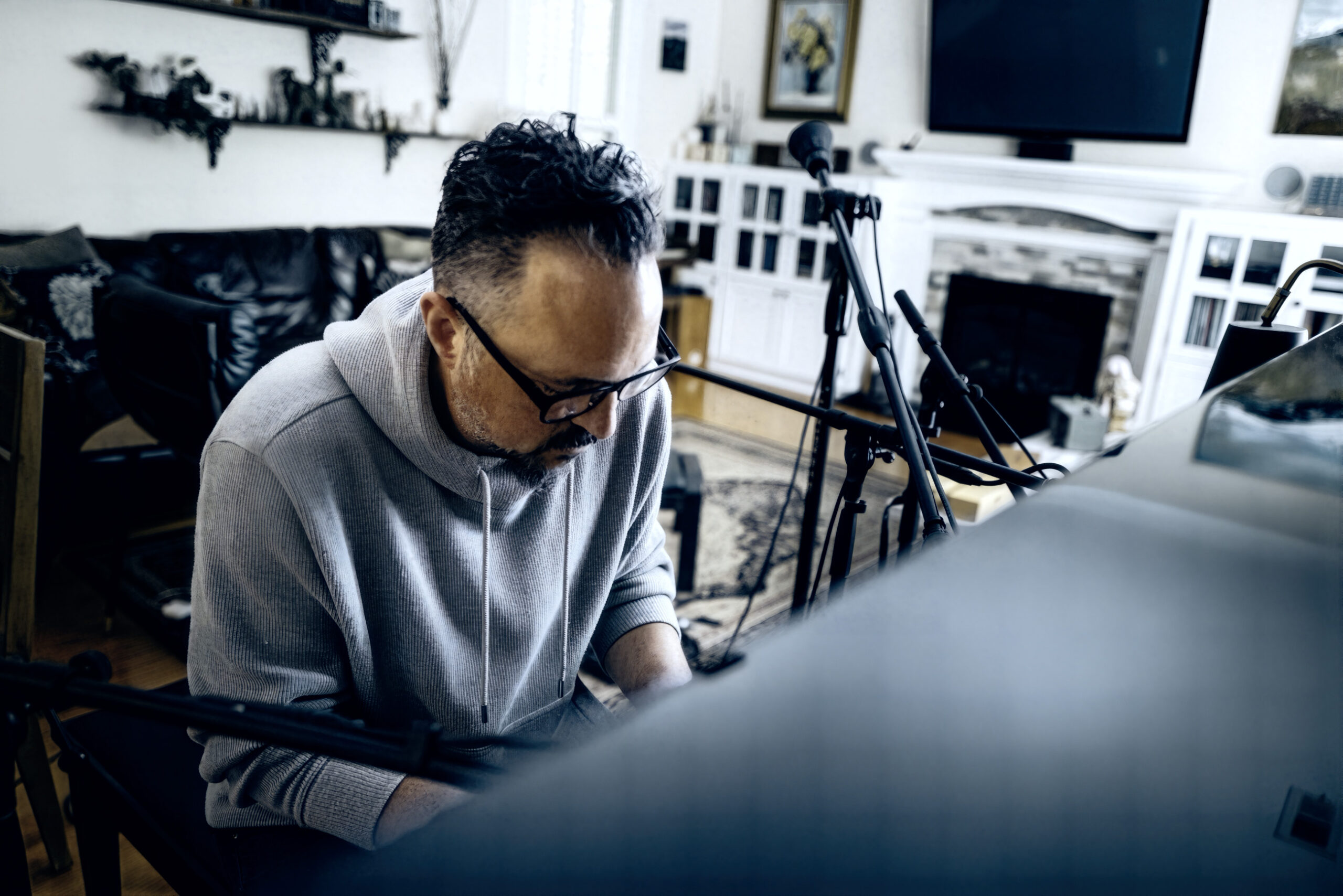
THE FIRST KEY
“I was fascinated not only by the sound, but by the mechanics of it.”
PRM: Your relationship with the piano began at a very young age. Can you take us back to those first encounters with the instrument? What was it about the piano that captured your imagination and made you want to keep coming back to it?
John Schroter: One of my earliest memories of a piano is actually an old player piano that sat in our garage. It was a detached, old-school concrete block garage with rocks on the ground instead of a paved floor, and right next to the door was this old player piano with sliding doors on it. My dad had picked it up because he hoped to fix it someday.
It was way out of tune and covered with a moving blanket, but when I was probably three or four years old I would sneak out there, lift up the blanket and mess with the keys. I remember being fascinated not only by the sound, but by the mechanics of it – pressing a key and seeing a hammer move, seeing all of those notes laid out in front of me and trying to understand what they did.
Around that same time I had a little toy xylophone, and eventually I could pick out melodies on it and make little harmonies with the two mallets.
Later my parents bought me a Yamaha PortaSound PS-300 keyboard in 1982 when I was 9 or so. It came in a tan case with a carrying handle and I took that thing everywhere with me. I still have it. I would put headphones on, make beats, play melodies, just disappear into it.
I grew up in the ’70s and ’80s, so piano and synthesizers were everywhere, and some of those sounds absolutely blew my mind.
“Tiny Dancer” by Elton John. “She’s Always a Woman” by Billy Joel. “You Put This Love In My Heart” by Keith Green. “Jump” by Van Halen. “Sweet Dreams” by Eurythmics. Everything about “Take On Me” by a-ha, but especially those synth melodies and arpeggios.
I still remember exactly where I was when I heard “Take On Me” on the radio through my Walkman in the back of our Oldsmobile station wagon and my mind being completely blown.
Who knew that piano and keyboards could do this?
I was hooked.
Classical music was also a huge part of our home. My dad loved it, and we listened to Handel’s Messiah, Schubert, Bach and Vivaldi all the time. The Four Seasons felt almost like rock music to me because of its energy and movement – it still does.
I was also fortunate to grow up near Philadelphia, where a few school field trips gave me the chance to hear the Philadelphia Orchestra perform live.
Then, leading up to Bach’s 300th birthday, my music teacher asked me to audition for a treble chorus made up of young singers from school districts around Bethlehem, Pennsylvania. About 500 of us were invited to audition and only 80 were chosen; I was selected to sing alto.
We spent the summer of 1984 immersed in Bach – learning how to blend, intonate, use head tone and hear all of those independent musical lines working together.
Eventually we were rehearsing with the Bach Choir of Bethlehem, accompanied by a real pipe organ, and performing that music in large churches throughout the region, culminating in the Bach Festival at the Lehigh University Packer Memorial Chapel.
I remember watching the organist use every limb to create this incredibly complex yet beautiful music while we sang “Jesu, Joy of Man’s Desiring” in our pure, innocent treble voices.
I was forever marked by that experience.
Around that same period, my mom bought me my first cassette, Michael W. Smith’s Project, and it opened with a synth-driven piece called “Sonata in D.” I remember hearing it and immediately rewinding it before I even got to the second song.
It was classical structure, Bach-like movement and synthesizers all colliding in one place.
Between that, hearing and singing with a live pipe organ, the classical music in our home and all of the piano and synth music on the radio, I knew that I needed to learn how to play.
Once I started taking piano lessons, I was always drawn to whatever piano happened to be in the room.
My aunt and uncle were very musical and whenever we would visit, I would just go upstairs, flip through some of my uncle’s records and play their piano while everybody else was downstairs hanging out.
I actually preferred it if nobody was really listening.
I liked being able to fill the room with music without having to be the center of attention.
Piano has always done that for me.
It clears my head. It calms me down.
Whether I was learning Bach or later writing my own music, there has always been something about sitting at a piano that makes me feel more whole, almost like both sides of my brain finally agree to work together for a while.
THE ARCHITECTURE OF TOUCH
“She essentially had to rebuild the physical way I approached the instrument.”
PRM: As a teenager, you studied intensively with the Cuban-born concert pianist Dr. Martha Marchena. What was that experience like for you as a young musician, and what aspects of her teaching still influence the way you approach the piano today?
John Schroter: I finally started formal piano lessons when I was 13. I had already been playing guitar for seven years, and piano came very quickly to me.
I remember learning a Bach prelude almost immediately, and within a year my first teacher told my parents that I had progressed far enough that I really needed to study with someone at a different level – ideally a concert pianist.
My parents were incredibly supportive. They invested in a Yamaha upright piano for our home and eventually found Dr. Martha Marchena.
I auditioned for Martha when I was about 15.
She is a Cuban-born concert pianist and teacher who immigrated to the United States in 1979 and built a career as both a performer and educator. She saw potential in me, but she also immediately saw everything I had never been taught.
I could play the notes, but technically I was a mess. My wrists were tight, my shoulders were up, and I was trying to generate everything with my fingers.
She essentially had to rebuild the physical way I approached the instrument. One of the things that has stayed with me most was learning where power and tone actually come from at the piano.
Martha is a very small woman, but she can sit down at the keyboard and produce this enormous and beautiful sound, all while her arms and wrists are perfectly relaxed.
She taught me that it wasn’t about attacking the keys harder with your fingers or relying on physical strength and stature. The weight and power could come through my arms and body while my hands remained relatively free.
I was able to hear her perform several times, and what stayed with me was seeing how all of that technique disappeared into the music once she was in front of an audience – how power, phrasing and interpretation could create a real emotional connection with the people listening.
She also taught me how to read a score differently.
Before that, I was mostly concerned with playing precisely what was written on the page. Martha taught me to ask what the music was saying – where a phrase was going, which voice needed to emerge, how the dynamics and articulation shaped an idea, how something written on a page could actually breathe.
We did a lot of Baroque and Classical repertoire – Mozart, Beethoven, Bach, Clementi – and some Schumann.
My favorite pieces were the Bach Inventions. I even attempted a fugue, although at that point keeping track of that many independent voices was a little beyond me – well, it still is! I performed a bit, was adjudicated and did well, and I took the work very seriously.
At the same time, studying with Martha helped me understand what becoming a concert pianist would actually require.
I practiced roughly two hours a day and felt like I had worked very hard, but I was beginning to understand that people seriously pursuing the concert-pianist path were building their lives around the instrument.
I loved piano, but I also loved track & field, biking, tennis, musical theater, singing and a lot of other things. I realized that I wasn’t willing to give all of that up to practice piano six to eight hours a day.
So in a way, Martha helped me discover both how serious I was about the piano and what I didn’t want my relationship with it to become. I knew I probably wasn’t going to pursue the concert-pianist path, but by then I also knew the piano was going to remain a central part of my life.
BEYOND THE CONCERT HALL
When music began speaking through images.
PRM: You later studied piano, voice, theory, and composition at Messiah College. How did those years deepen your understanding of music, and did they begin to shape the kind of pianist and composer you wanted to become?
John Schroter: By the time I graduated high school, I already knew I wanted to compose and perform.
My high school music theory and choir teacher had graduated from Messiah College, and when I was trying to figure out what to do practically with music, he suggested that I pursue a music education degree there.
I auditioned in both piano and voice and was admitted. The funny thing was that I had only been playing piano for about two years when I arrived there, and suddenly I was surrounded by virtuosos and prodigies – people who could sight-read music the way most people read a book.
I realized very quickly that I could play and I had musical instincts, but in terms of raw speed, technique and sight-reading, I was nowhere near some of these people.
I absolutely loved being in that environment, though. There were practice rooms with grand pianos. There was a harpsichord. There was a small pipe organ I could actually get my hands on.
I was taking composition and theory, learning how to teach strings – violin, viola, cello, bass – learning brass instruments, playing timpani in the wind ensemble, performing Handel’s Messiah and touring New England with the choir, and performing in musical theater.
I loved being surrounded by people who were thinking about music all day long. But the people I naturally gravitated toward and hung out with the most were not the music majors but the communications students, the film people, the radio DJs, the actors, set-builders and visual artists.
I started realizing that the thing I seemed to have naturally was an ear for sound, rhythm, timing and emotion, and that those instincts did not have to live only inside traditional music performance.
That eventually led me to study Radio, TV & Film, but I never really felt like I was leaving music.
In fact, I was pleasantly surprised to discover that visual storytelling is a medium where a lot of the same musical and rhythmic instincts really matter, especially in editing – where performance, image, sound, music and timing all have to come together cohesively, almost like conducting an orchestra, with the goal of shaping all of those elements into something that ultimately moves an audience.
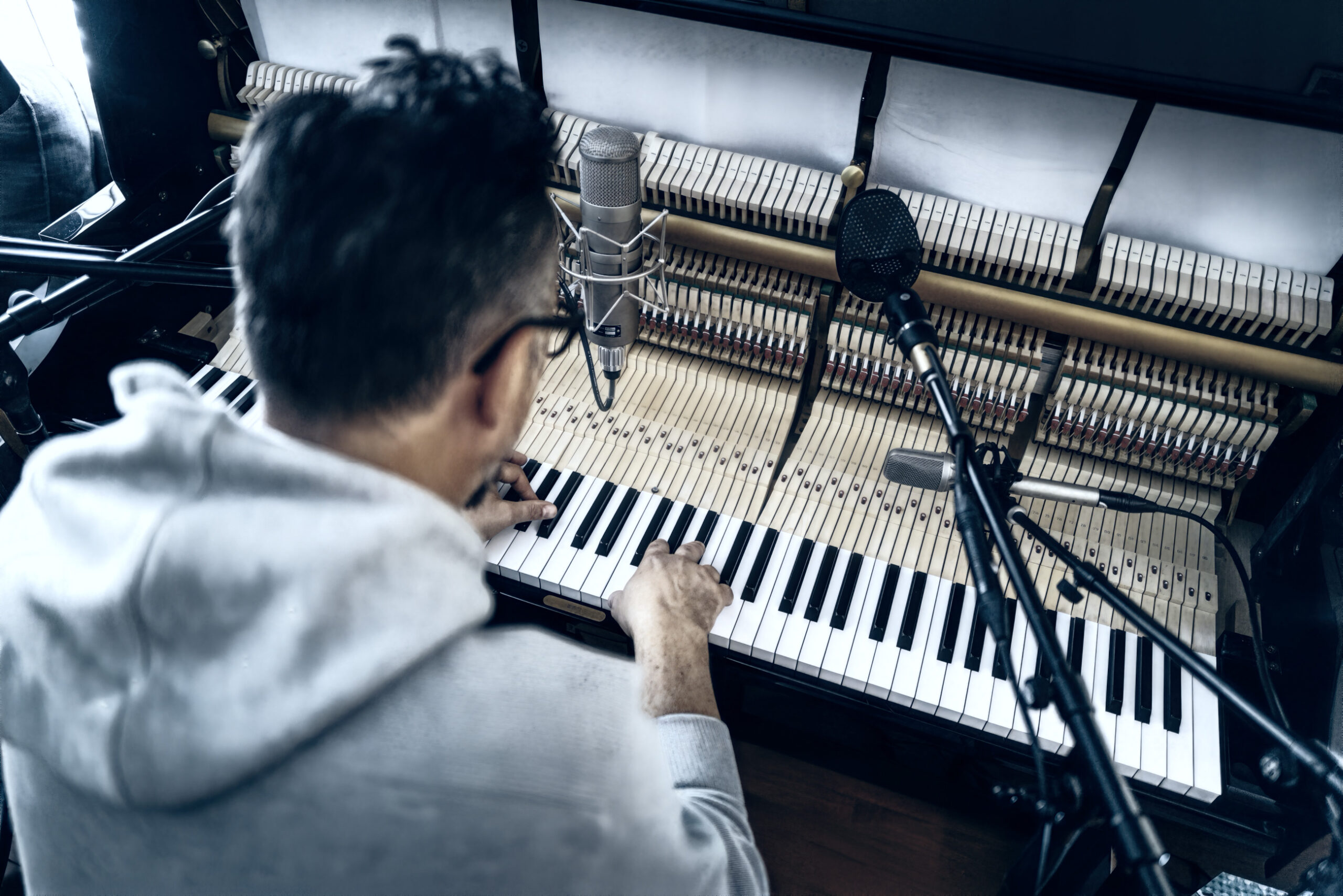
CUT TO SILENCE
Film, rhythm & the art of restraint
PRM: For a significant part of your professional life, you immersed yourself in film – working as an editor, colorist, finishing artist, and studio owner. When you look at that chapter alongside your life as a musician, what connections do you see between shaping a film and shaping a piece of music? Did working with image, pacing, silence, atmosphere, and emotion change the way you listen?
John Schrote: That is a very good question – one I hadn’t thought about before.
I ended up spending the past three decades working in film and television, primarily as an editor, colorist and finishing editor, and I think that career has shaped me musically much more than I realized at the time.
Editing is fundamentally about rhythm and finding the essence of a thought in order to build a story arc.
You are constantly making decisions about what to cut, when to cut, how long to hold on something, when an audience needs information and when they need space to feel what just happened.
A few frames can completely change the emotional effect of a moment. If a piece isn’t paced properly, it will fall flat – even if the content itself is compelling. In fact, when I edit a story or documentary, I always make sure it works with no music and no visuals first.
If I build that foundation correctly and the story moves me as a “radio edit,” then the rest of the job becomes much easier: add the music and sound effects it needs, build out the B-roll, and don’t screw up what was already working.
Just make it stronger.
Music works the same way.
Sometimes the most important decision is not what note to play next, but how long you are willing to wait before playing it. Working in post-production also taught me a lot about restraint.
You can always add another shot, another effect, another layer of sound, another piece of music. The harder skill is recognizing when something is already doing its job and having the confidence to leave it alone.
Color grading is similar. Very small changes can completely alter how an image feels, and if you keep pushing simply because you have the tools available, you can quickly destroy the thing that made the image beautiful in the first place. Most importantly, I need to understand the tone of a film, emotionally and visually, before I can complement or enhance it with the color grade.
I think that sensibility has found its way deeply into the music I’m making now. I’m much more interested in finding the essential thing than demonstrating everything I know how to do. And then there is storytelling.
Every good story needs a beginning, middle and end. That sounds simple, but getting those pieces to work together emotionally is not easy.
I’ve spent most of my career sitting with performances and interviews trying to understand what someone is really communicating – the truth beneath the words – and then shaping everything around that so an audience can feel it too.
Picture, sound, music, silence, pacing, color: they all become part of one emotional language.
After doing that for so many years, I think I naturally hear my own compositions in terms of pacing, movement and emotional arc. Even when there is no literal story attached for the listener, there almost always is one for me.
Music never stopped for me during those years. I continued playing, writing and improvizing, particularly in church and at home, often as a form of prayer and meditation.
I wasn’t thinking of myself as a recording artist or trying to build a catalog. Film became the place where most of my professional creative energy went.
Looking back now, I think I was developing many of the instincts I use as a composer without fully realizing it.
In that sense, returning to solo piano now feels less like going back to something I left behind and more like bringing several decades of experience back with me.
I hear space differently.
I understand pacing differently.
I’m more comfortable with silence, with simplicity, and with allowing an idea to take the time it needs.
The tools are different, but the question is remarkably similar to the one I’ve asked throughout my career:
What does this moment actually need in order to move someone?
A WIDER MUSICAL UNIVERSE
Bach, George Winston, Nils Frahm – and the synthesizer that never left.
PRM: What have been the strongest influences on your taste as a pianist and composer? Are there particular composers, pianists, recordings, genres, or musical traditions that have stayed with you and continue to inform what you create today?
John Schroter: My influences are pretty broad.
Bach is probably the deepest and most enduring one, and obviously Elton John, Billy Joel, Keith Green and Michael W. Smith had a huge impact on me early on.
But George Winston really changed my understanding of what solo piano music could be.
I remember hearing December in the 1980s and being struck by how much emotion and atmosphere could come from one person at one piano.
Then I dug into the rest of his catalog.
There was space in it.
Repetition.
Simplicity.
It could be intimate and still feel enormous.
That stayed with me.
For a long time, though, I was playing a certain way without really having a name for it.
I would improvize, repeat figures, let a simple left-hand pattern sit there while a melody developed over it, and I wasn’t thinking about genre.
Then sometime around 2016, my oldest daughter introduced me to Nils Frahm and Ólafur Arnalds, and I remember thinking:
“Oh – I’m not the only one hearing the piano this way.”
I eventually discovered the term neoclassical, or contemporary classical, and started finding artists like Federico Albanese, Ludovico Einaudi, Joep Beving and Hania Rani.
It was interesting because I wasn’t hearing a style I suddenly wanted to imitate so much as recognizing a musical language that already felt familiar to me.
Nils Frahm in particular has become a huge influence.
My wife and I have seen him perform three times now, and I love the way he approaches a live performance almost as if he has brought his entire studio onto the stage and invited us in.
Pianos, synthesizers, electronics, acoustics, live sampling – he understands frequency, tone, movement and pacing at such a deep level.
There is very little talking or explaining.
He just creates this world and lets you enter it.
His work combines acoustic piano and synthesizers very naturally, which is probably part of why it resonates so strongly with me.
There is still a lot of ’80s kid in me, and that is never going away.
I love synthesizers.
I love a strong melody.
I love something that builds.
I love Baroque movement and counterpoint, but I also love repetition and simplicity.
So when I sit down to write now, all of those things are somewhere in the room with me – Bach, George Winston, Keith Green, Michael W. Smith, the synth music I grew up with, Nils Frahm, Ólafur Arnalds and the other contemporary composers I’ve discovered along the way.
I don’t consciously try to combine them.
At this point, they’re just part of how I hear music.
THE BEAUTY OF LESS
“Sometimes one note changing inside a harmony can affect me more than an elaborate progression.”
PRM: Your music has a distinctive sense of space and restraint. There is often a feeling that every note has been carefully considered, without ever sounding overly constructed. How did you develop this musical language, and what does simplicity mean to you as a composer?
John Schrote: Thank you.
I really appreciate that, because it is something I’m being very intentional about right now.
I’m trying to keep the music as close as possible to its core: melody, harmony, and enough space inside the form for the performance itself to breathe.
There’s a vulnerability in releasing something as exposed as solo piano, but that vulnerability is also what draws me to it.
I don’t want to fill every available space just because I can.
I think a lot of that probably goes all the way back to Bach and to singing choral music.
When you spend time listening to independent voices move against one another, you start hearing harmony less as a stack of chords and more as individual lines having a conversation.
I still love sitting at the piano and experimenting with voicings – moving one note inside a chord, holding another while everything underneath it changes, or discovering how much emotional movement can happen while barely changing anything at all.
That has become increasingly interesting to me.
Sometimes one note changing inside a harmony can affect me more than an elaborate progression.
If the melody is strong enough, I want to give it room to speak.
And then there is expression.
If every element is locked down too tightly – harmony constantly moving, left hand constantly busy, every space filled – there isn’t much room left for discovery while I’m actually playing.
I like having a form that is strong enough to hold the piece together but open enough that touch, timing, dynamics and silence can change from one performance to another.
That’s probably where I feel most at home right now.
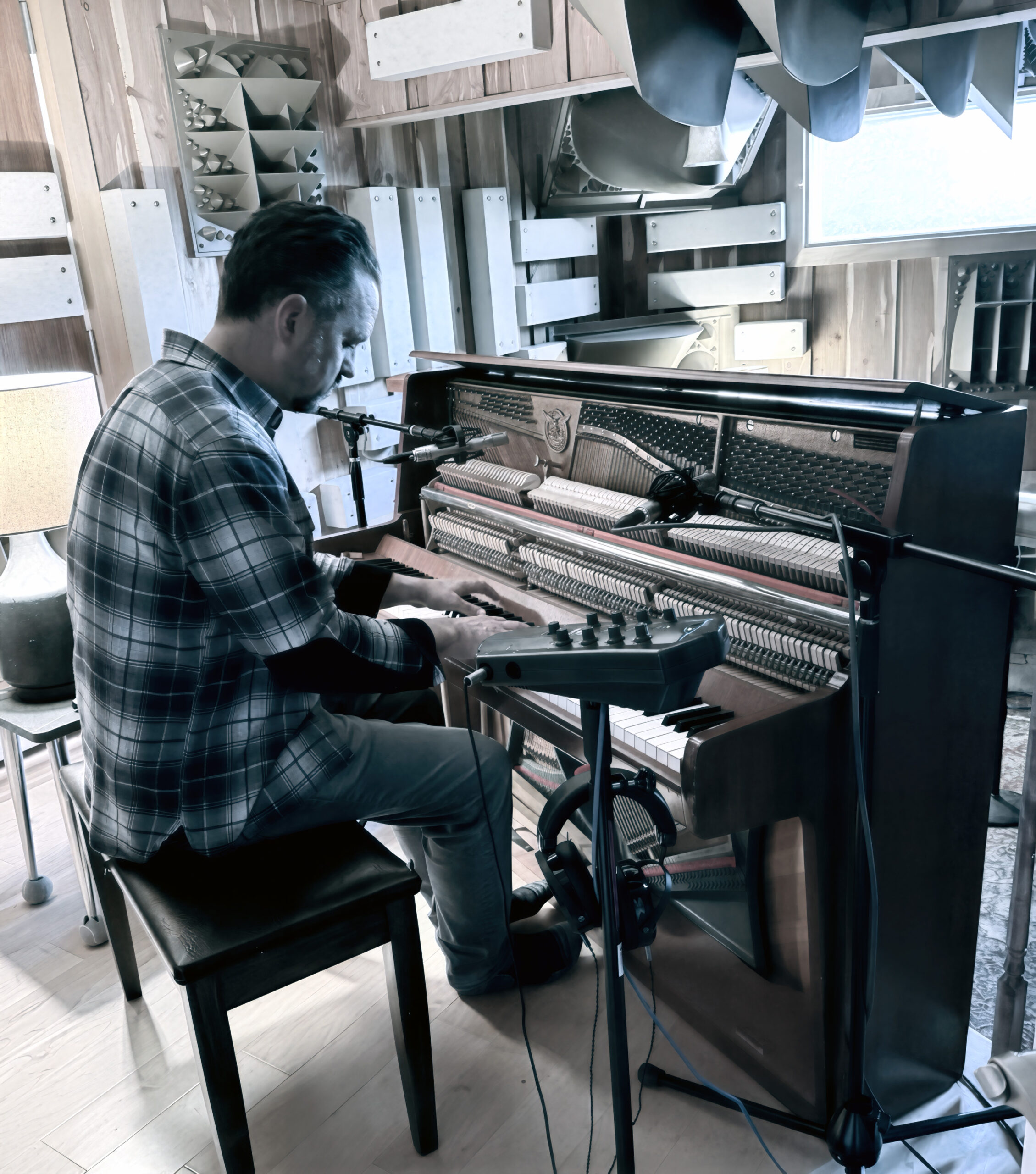
THE PIANO HAS A PERSONALITY
Listening to the instrument before deciding what it should become.
PRM: You seem particularly interested in the character of the acoustic piano itself – its touch, resonance, warmth, and even the small mechanical sounds that remind us that this is a physical instrument being played in a real room. How important is the personality of the instrument to the music you create?
John Schroter: For me, the instrument itself is incredibly important.
That’s true whether it’s an acoustic piano, a guitar, or a synthesizer.
One of the most enjoyable parts of playing music is discovering what the instrument wants to say.
The way a note rings out, the way a guitar smells, the way the knobs feel on a synthesizer, the weight and resistance of the piano keys under your fingers – even the way one particular note on a given day is ringing at just the right frequency.
Sometimes the best thing you can do is listen to that and build from it.
I think that is a big part of the essence of playing and composing for me: feeling, listening, waiting, and then combining all of that information into a musical story.
I don’t necessarily come to the piano with everything decided in advance.
The instrument is giving you feedback all the time, and I want to leave enough room to respond to it.
I’m currently writing some new music on a Cable-Nelson piano that is about a hundred years old.
It has been repaired and reworked over the years, and it is far from mechanically uniform.
Some keys feel slightly different from others, certain notes resonate in unexpected ways, and playing it can feel like a discovery in and of itself.
I hesitate to use the word “character” because it gets used for everything, but this piano really does have a personality that affects what I play.
When I record, I don’t know if I’ll ever completely capture what I hear and feel when I’m actually sitting there with my head just inches from the hammers and strings, hearing the soundboard vibrate and the sympathetic resonance of other strings joining the note I just played.
That physical experience is enormous, even when the music itself is very quiet.
Trying to preserve some of that in a recording is part of what makes recording interesting to me.
I’ve heard people capture that intimacy beautifully, and it makes me want to keep experimenting with how I record.
But it also reminds me that there is something about simply being in the room with an instrument – whether I’m playing alone, in a small gathering, or for a larger audience – that a recording can never completely replace.
FULL CIRCLE
The recording born from memory, friendship and a moment that could no longer wait
PRM: Your debut single, “Place,” introduced listeners to this intimate piano world, while Full Circle takes the idea further. What was the musical starting point for the EP, and how did the pieces and overall sound develop during the recording process?
John Schroter: I had a handful of original pieces that I had been playing and refining for years, some going back to around 2015, with themes and motifs going even further back.
Because I work in post-production, there are always moments when I’m waiting on an export or a render, and I would often walk over to the piano in my studio and just play.
Sometimes it was an exercise, sometimes an improvisation, and every once in a while something would stand out enough that I’d think, I should record that someday.
I kept voice memos and little ideas, but “someday” always meant when I had the time, when I had the money, when everything lined up.
All real factors – but I had been getting close to recording for years and then simply not doing it.
A friend of mine, Mike Cavell, a sound engineer in the film industry, spent decades building out an amazing studio in his home.
Almost every time I saw him he would invite me over to come record some music.
He’d always smile and say, “We’ll just hit those keys and see what happens.”
At one point we actually had a date set but something came up and I had to cancel.
But it was always in the back of my mind that I’d make it there someday.
Then in April of 2025, Mike died suddenly and unexpectedly, and it hit me hard.
It hit everyone hard.
He had a really big influence on a lot of people’s lives.
“Someday” now hits very different for me.
By September, William Price, another friend of mine who was very close to Mike, reopened Mike’s studio.
This time I had zero hesitation – I texted him immediately about recording the two piano tracks for Place.
I chose very simple piano pieces because I wanted to leave room around them.
I was originally thinking synthesizers and strings, but William is an amazing guitarist and producer with an incredible palette of sounds at his disposal, so we naturally started moving in that direction.
After I recorded the two piano tracks, we recorded his electric and acoustic guitar parts, bass parts, and added some other cool touches.
My friend Leo Solis mixed the tracks through Mike’s Neve console, which gave that little acoustic piano way more depth than it had any business having.
It was kind of unreal.
There was also a little detail that meant a lot to us: the studio computer was still named “Mike Cavell,” so while I was AirDropping files during those sessions, I was literally sending them to “Mike.”
It felt like Mike was still present in the room with us, and that brought us a lot of comfort.
I loved what came out of those sessions, but being together with friends and family – recording, experimenting, listening back and watching an idea become something tangible – was incredibly fulfilling in itself.
After Place was mastered, I started preparing my own piano with felt, and within about a month I had written four new pieces that became Full Circle, alongside the previously written “Gethsemane”.
Those pieces were being written during a really interesting season for my family.
My wife and I were expecting our first grandson, while also watching our own children begin to experience things that we had lived through a long time ago.
There was this sense of life coming around again – family, memory, faith, joy, loss, beginnings.
The interesting thing is that I usually didn’t sit down and decide what a piece was about first.
The music tended to come out before the explanation did.
I would write it, live with it for a while, and then begin to recognize the emotion or story that had found its way into the notes.
CLOSE TO THE WOOD
The sound of an imperfect piano – and why perfection was never the point.
PRM: When you were making Full Circle, how consciously were you shaping its intimate sound, and how much did you allow the piano, room and performance itself to dictate the final result?
John Schroter: A lot of that sound was intentional from the beginning.
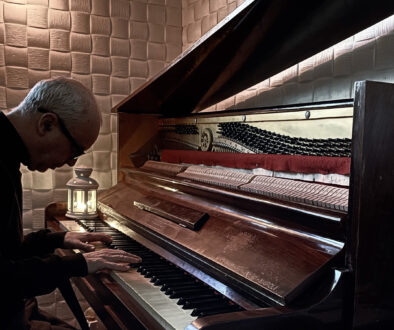
I knew I wanted Full Circle to feel very close and personal, so the plan was to record the entire EP in one day, at home on my Essex upright, with Jacob Early engineering.
Jacob is a terrific singer-songwriter and producer who has worked with artists like John Mark McMillan, Andy Squyres and Jess Ray, and he has such a great presence about him.
I’ve known him since 2008 and this was our first time working together on a project.
I’m really fortunate to have so many friends nearby in the recording industry – one of the cool things about staying in one place long enough is the genuine relationships you build over the years.
I had already been experimenting with felt on the piano, and I loved the way it softened the attack and brought out this warmer, more intimate character.
At the same time, I didn’t want to over-control it.
The room has its own sound, the piano has its own response, and every performance has little variations that make it human.
Part of the point was to let those things remain part of the recording rather than trying to turn it into some idealized concert-piano sound.
We were listening for what the instrument and room were giving us and then trying to capture that honestly.
I should have tightened up my piano bench before recording, though!
There are a few extra squeaks I didn’t intend to pick up, but that does make it more real.
Because of my background in post-production, I’m very aware of how much you can manipulate something after the fact.
That actually made me want to do less.
I wanted the recording to feel like sitting close to the piano and hearing the felt, the wood, the pedal, the sympathetic resonance and all of those little physical details that happen around the notes.
The goal wasn’t perfection.
It was intimacy.
Recording everything in one day helped with that too.
There was a consistency of mood and sound, but also a little pressure to simply play and commit.
I think that kept us from overthinking it.
Jacob did a great job of capturing what was already there rather than imposing a sound on it, which is exactly what I wanted.
WHAT COMES AFTER THE CIRCLE?
On curiosity, limitations and the freedom to forget the rules
PRM: Having returned to the piano as a recording artist after such a rich career in film and post-production, where do you feel you are musically today? What are you still curious about, and what would you like to explore next as a pianist and composer?
John Schroter: The obvious answer would probably be writing for film and television, but I don’t think that’s quite it for me right now.
Don’t get me wrong – I would welcome any opportunity to rearrange, license or rework these compositions.
A lot of what I write is actually a stripped-down version of something that can sound much more epic in my head.
“Gethsemane”, for example, is something I wrote more than ten years ago, and it originally began as a song with lyrics.
The B section, or chorus, was written from the perspective of Jesus in the garden the night before the crucifixion, simply wanting his closest friends to stay awake with him.
I would love to make a choral arrangement of that piece.
There are others I can imagine orchestrating, or hearing reworked through an electronic collaboration.
I think all of my music has those larger possibilities living just beneath the surface.
But what is most interesting to me right now is almost the opposite – stripping everything down to its core essence and seeing what is left.
Everything I write is personal, and there is a story or an emotion behind it, but I generally let that come to my fingers unprompted.
Where can a melody take me if I let it lead?
What happens if I change the left hand as little as possible?
What if I only play the black keys?
What if, for a few minutes, I pretend I know nothing about music theory, key signatures or meter?
I find those questions, and the music that comes out of them, fascinating.
There is something very freeing about creating my own limitations and then exploring inside them.
Early in my video editing career, I worked on a project with a very limited budget but a very ambitious scope – as many do! – and somehow ended up creating some of my most inventive work to date.
I had a great leader in our department who encouraged us to take note of those kinds of milestones and distill them into something succinct and memorable.
What hit me that day was this:
Limitations are the canvas of creativity.
It may seem ideal, but if you were actually handed an unlimited budget, unlimited time and unlimited possibilities, you could easily end up overthinking, reworking and trying too many things.
Creativity often flourishes when there are boundaries.
That lesson has stayed with me ever since.
Editing and color grading have an exploratory side too, but there is always a brief attached – an audience, a story, a marketing goal, a budget, a deadline.
Those constraints are a necessary part of professional creative work, and I’ve spent most of my adult life working within them.
With my own music, the difference is that I get to decide what the constraints are.
I can follow something simply because I’m curious about where it goes.
So I don’t really have a grand plan for what this becomes next.
I will keep writing, continue releasing music, and remain open to all of those other possibilities when they make sense.
But I’m truly fascinated by the piano itself and by trying to approach it with something of the wonder of a child discovering it for the first time – pressing a key and hearing a string resonate, adding another note and suddenly discovering harmony, without yet knowing what any of it is called or what you’re supposedly allowed to do with it.
There is something wonderful about knowing all the rules and then giving yourself permission to forget them for a little while.
I think I’m trying to get back to that place – sitting at a piano, sticking my head right in there, asking:
“What happens if I do this?”
And being genuinely surprised by the answer.
EPILOGUE
THE PLACE WE RETURN TO
Perhaps Full Circle is not really about returning to where we began.
Perhaps it is about discovering that we never truly left.
John Schroter’s journey has moved through garages and concert halls, church music and classical repertoire, film studios and editing suites, family milestones and personal loss. Yet beneath all of those chapters there has remained one constant: the piano as a place of curiosity, refuge and possibility.
What is striking is how little his return to the instrument feels like an attempt to reclaim the past.
There is no nostalgia for virtuosity.
No desire to prove how much he knows.
Instead, there is a willingness to listen.
To wait.
To leave a note hanging in the air.
To allow an old piano to squeak.
To let a melody arrive before its explanation.
And perhaps that is the most beautiful thing about John Schroter’s current chapter: after decades spent shaping stories for other people, he is now allowing the piano to tell his own.
The circle closes not with an ending, but with a question.
A child presses a key.
A hammer moves.
A string begins to resonate.
And somewhere, decades later, the adult is still listening for what happens next.
What happens if I do this?
Perhaps the answer is the music itself.
JOHN SCHROTER
Full Circle
A Piano Revenge MAG Conversation