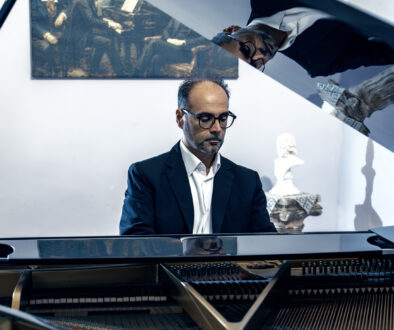
Piotr Zalewski: Dancing with the Universe – From the Ocean to the Piano
The most interesting artists don’t “reference” a landscape; they metabolize it. For Polish composer, pianist, and producer Piotr Zalewski, the sea isn’t scenic background – it’s a private syntax: memory, pulse, and method.
He works where contemporary piano, ambient atmospheres, and cinematic scale meet – letting a single, intimate motif bloom into orchestral colour, synthesizers, or voice when the piece asks for it. The starting point is rarely a plan. It’s a sensation – and a willingness to follow it.
“Everything begins with the sea. Not as a place, but as a feeling – something vast, breathing, impossible to hold.”
From his debut album IMAGO to the piano trilogy bezdeń, his collaboration with the legendary Lubomyr Melnyk, and his latest studio album Wind Tales, Zalewski has been building a body of work that treats nature less as muse than as architecture – an invisible system of tides connecting imagination, craft, and the inner life.
In April 2027, Piotr Zalewski will join the main selection of Piano Revenge Festival in Paris. Ahead of the performance, we spoke with him about improvisation and instinct, fatherhood as creative engine, the discipline of listening, and what it means to let the music lead.
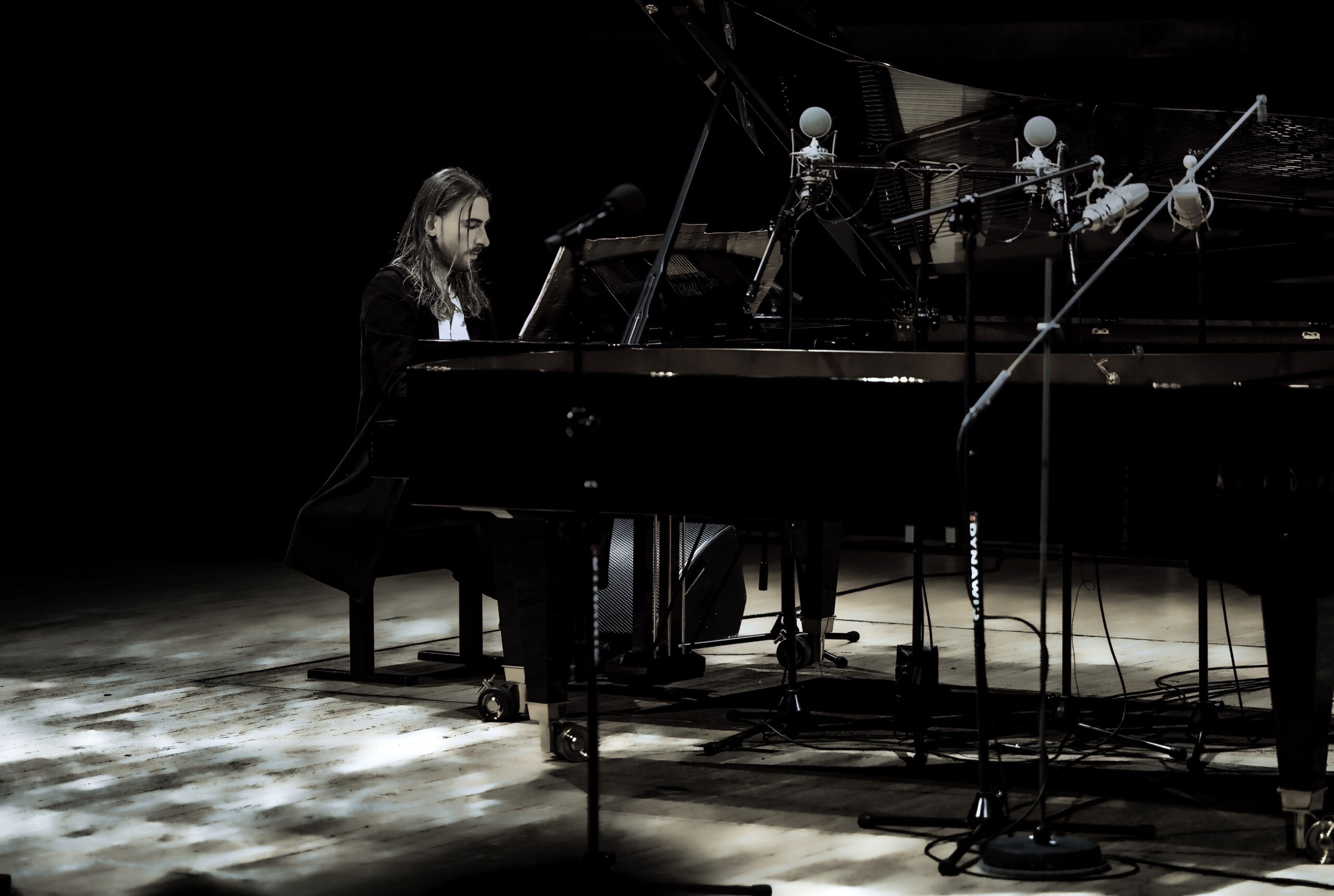
The seed appeared the very first time I touched a piano key
PRM: When and how did you realize that your whole life would be linked to music?
Piotr Zalewski: It was a process. But the seed of that feeling appeared the very first time I touched a piano key. Then I began to explore its sound, to create my first musical forms. Eventually, I realized that this is my language of expression. Through the “wordless” voice of the piano, I can most honestly convey what I feel. There is something very special about an instrument that can say so much without using a single word. For me, the piano became that voice.
The revelation of Lubomyr Melnyk
PRM: Which composer has most influenced your musical imagination?
Piotr Zalewski: There have been several – I have my own “top ten” 🙂 But here I would like to mention someone who was a true revelation for me and who set the direction of my musical exploration: Lubomyr Melnyk and his “Continuous Music.” I had the privilege of studying with Lubomyr, and later we began an artistic collaboration, which resulted in a live album recorded on October 3, 2025, during our concert at the Witold Lutosławski Concert Studio of Polish Radio in Warsaw. Meeting an artist whose approach to the piano is so radically connected with movement, continuity and physical energy had a profound impact on my own musical exploration.
Don’t think. Just play.
PRM: What is your main creative motto?
Piotr Zalewski: Don’t think. Just play. Let yourself be carried. Immerse yourself in the ocean of sound. It’s a line that reads like minimalism, but functions like a door: step through, and control starts to feel optional. In Zalewski’s world, composition is as much about removing interference as it is about adding notes – clearing space for instinct to surface. That outlook becomes most vivid in his relationship with improvisation.
PRM: Your creative philosophy suggests that improvisation is almost a form of surrender. Do you feel that you are composing music, or discovering something that already exists somewhere within you?
Piotr Zalewski: Improvisation is, in a way, the very first stage of composing. It is an act of pure intuition. I am here and now. It doesn’t matter what has happened or what is going to happen. It is a beautiful feeling, almost comparable to happiness. Especially when the piano seems to guide your fingers and hands by itself.
Of course, it doesn’t always happen that way when you improvise. You need a clear mind – undisturbed by any thought. Any problem. Any feeling or emotion. A blank canvas. Nothingness.
And then you begin to draw. And you don’t know what you are drawing. But you are filled with enthusiasm and fascination with the process itself. I believe that everyone is capable of improvising and creating, even a beginner, limited by their technical skills. What matters is that, during the process, they are not distracted by unnecessary thoughts. The best thing you can do is, for a moment, destroy your ego. That is when the real creative process begins.
It is as if you are being guided by a higher force that you are, in fact, already a part of. You connect with something greater, something universal. Or perhaps it is more accurate to say that you are connected to it all the time, but when you switch off your rational mind, you become aware of that connection. You don’t necessarily understand it. You simply feel it. And then you play, and your hands take you somewhere on their own. In your own way. Within the limits of your abilities.
You dance with the Universe.
From the ocean to bezdeń
The sea has been in the room since the beginning: childhood proximity, then the adult reality of working at sea – vastness not as metaphor, but as lived scale. Over time, it becomes internal; the horizon turns into a kind of tuning fork.
PRM: Your biography speaks of the sea as the central inspiration for your work – “Everything begins with the sea.” Having worked at sea yourself, how did that physical experience of the ocean’s vastness and rhythm translate into the piano compositions on bezdeń?
Piotr Zalewski: I would describe it more as a metaphysical, almost transcendental experience.
Of course, it begins with observation, with looking into the distance, with admiration. But at some point, that immense vastness begins to coexist within you, even when you are no longer looking at it. You can feel its presence. Its energy. As if the water in your body somehow merges with the waters of the ocean and becomes one with it. And that is when music is born – as an expression of what you are feeling.
This is what bezdeń is: the “deepest” piece in this cycle. It was born from the very essence, from the source of life, from the mysterious depths of the ocean.
Then come syreny and the other fantastical creatures. That is another level of creation, where imagination takes the leading role. I associated dolphins with mermaids – beautiful creatures filled with love, a peaceful energy of communication, and an extraordinary kind of wisdom.
And finally, we reach the surface. Fale is pure expression. It is also the moment when water encounters the wind, and together they dance, twist, and tease each other. At each of these levels, my hands seem to find their way across the piano on their own.
Intuitively, I choose the texture, and I am carried by an energy that is difficult to explain – an energy that I don’t know where it is taking me.
Wind Tales: a story born from fatherhood If bezdeń is oceanic depth, Wind Tales is weather with a personal forecast. Released on February 27, 2026, the album reframes Zalewski’s nature-fascination into something intimate – its dedication a clue to its emotional temperature. Dedicated to his daughter, Maria, the album tells a fantastical story inspired by Hans Christian Andersen, The Little Prince and the dreamlike darkness of Pan’s Labyrinth. At its center is the Wind, traveling through a mysterious world until he encounters Melody – a girl born from the Sea.
PRM: Wind Tales is a deeply narrative album, blending influences from Andersen, The Little Prince and Pan’s Labyrinth to tell the story of the Wind meeting Melody. How do you translate a narrative, with characters and a journey, into instrumental music? And what was it like dedicating such a fantastical work to your daughter?
Piotr Zalewski: The translation of the narrative doesn’t happen solely on the instrumental level.
I was aware that the music itself would not necessarily lead the listener toward a specific story. Music conveys emotions, shapes a particular esthetic and atmosphere, and gives things depth. But if you want to tell something specific, you need words. And the words are there.
The first seven tracks of the album – the main story – are interwoven with short spoken passages, essentially narrations. My close friend Claudia, who has excellent English and impeccable diction, reads individual chapters of the story I wrote.
The story is, of course, not presented in its entirety. Perhaps one day I will take on the challenge of writing the whole book. For now, what remains is more of a simple narrative outline and its underlying message. The aim is to create a certain esthetic, a fairytale-like atmosphere in which music takes the leading role, while the text serves solely to convey something specific.
Words have the power to describe something precisely, whereas music is an ambiguous and universal language. And Wind Tales is dedicated to my daughter.
That is a wonderful feeling. 🙂 But it wasn’t the case that I came up with a story, wrote the text and music, and only at the very end decided to dedicate the work to my daughter. Quite the opposite. Everything began with Maria.
She was the impulse behind creating this musical story. She is Melody in the story – a girl born from the sea. And I am the wandering, searching, observing Wind.
The idea for the album actually began to emerge unconsciously from the very beginning of my fatherhood. Watching this little human being grow over the years, with her enormous imagination, turned out to be an inexhaustible source of inspiration. So, in a way, Wind Tales was born over almost seven years – and it is still evolving.
My experience of fatherhood, combined with my fascination with the sea – I spent most of my childhood by the sea – and my journeys across the ocean became the matrix for this fantastical story.
Knowing when the piano needs more
Zalewski’s work may begin at the keyboard, but it doesn’t have to stay there. Orchestral hues, synth glow, and voice can arrive – not as garnish, but as structural decisions, like changing the cut of a garment to make the silhouette land.
PRM: As a pianist known for the raw intimacy of the keys, how do you decide when to step back and let the piano speak alone, versus when to build a vast, cinematic soundscape around it?
Piotr Zalewski: It really varies. I often find myself struggling with this decision. There is no shortage of experiments, or failed attempts. There are pieces where I immediately know they will need some kind of support, and others where the opposite is true. Adding other colors would destroy the effect. In about 95% of cases, I naturally begin with the piano.
Sometimes I listen back to a recorded piano part and think, “This could use a little orchestral color,” so I start adding those layers. And it turns out the idea works. The recorded piano is carried by powerful layers of other instruments. Everything sounds beautiful. It works. But sometimes it is completely the opposite.
I record the piano. I add layers. I listen… and then I throw everything away. I’ve gone too far. I’ve lost the essence. There is no golden rule. What matters is listening to your inner voice, your first impression, and above all, your intuition. If all of that becomes overshadowed by the rational mind – or, even worse, by creating an effect simply for the sake of an effect, or for commercial reasons that have nothing to do with the message – then you lose authenticity.
You destroy the soul of the piece.
And then you have to return to the source.
A performance as a state of being
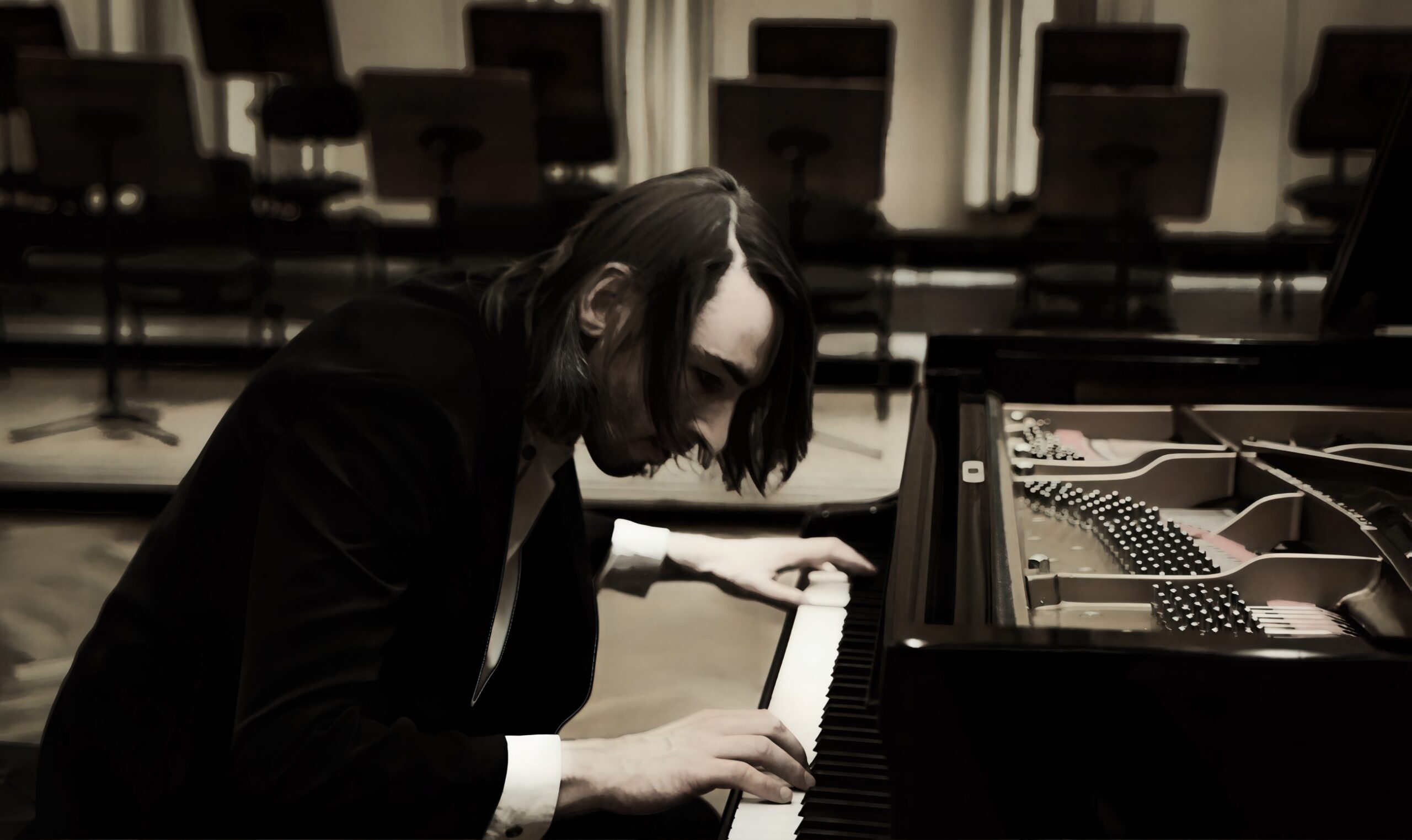
That return-to-source ethos will be a live proposition when Zalewski appears at Piano Revenge Festival in Paris in April 2027 – not as a recitalist “presenting” work, but as an artist treating the stage like a tuned space for connection.
PRM: What would you like to express during your performance at the festival? What will your programme consist of, and why have you chosen it?
Piotr Zalewski: I would like to express as clearly as possible what is currently playing in my heart. I don’t know if it’s fully possible, but I would love the audience to feel exactly what I feel when I touch the piano keys. In those moments, I feel unity with the instrument, but also a strong sense of being in the right place at the right time. I accept everything as it is. I don’t try to change or improve anything. I am authentic.
I feel free, aligned with myself, real – connected with everything around me. My dream is that people listening to my music feel something similar, and that these emotions and qualities stay with them in everyday life.
I will perform a diverse programme, strongly inspired by Lubomyr Melnyk’s cascading sound textures. At the same time, I will contrast this expansive, ambient sound with more intimate, minimalist textures – closer to the piano language of Nils Frahm – as well as lyrical melodies reminiscent of Yehezkel Raz or Joep Beving.
It promises to be a performance built around contrast: density and silence, movement and stillness, expansive sound and intimate melody.
Paris: “I truly want to spread my musical wings” Paris is less a familiar city in his story than a charged symbol – cinematic, mythologized, and, crucially, unknown enough to feel like possibility rather than routine.
PRM: What does Paris represent for you? Do you have a special relationship with the city, and why did you accept the invitation to participate in the festival?
Piotr Zalewski: To be completely honest, I’ve only been to Paris once or twice, and I don’t know the city very well yet. I know it more from stories and films than from personal experience. I would really love to discover it more deeply and feel for myself everything that is so often captured in cinema.
I have a sense that Paris can be artistically liberating – that it allows you to spread your wings. And I truly want to spread my musical wings and go further into the world. Being invited to your festival is something truly special. How could anyone refuse such a beautiful initiative?
Sharing my music in such a romantic city, surrounded by wonderful musicians from across Europe – and perhaps even the whole world – is an inspiring and tempting vision.
No – this is not the kind of invitation one turns down 🙂
Beyond the stage: a piano on the road
His ambitions have range: more international concerts, continued collaboration with Melnyk, and new releases already waiting in the wings. And then there’s the image that sticks – the piano, unmoored from formal halls, put back into the elements.
PRM: What goals do you set for yourself, and what projects do you have on the horizon?
Piotr Zalewski: First of all, I want to perform more concerts – especially abroad. I have a list of many wonderful festivals and I plan to apply to them. I also intend to continue my collaboration with Lubomyr Melnyk. I already have nearly finished material for two more original albums, and I would like to release them later this year.
I also have a slightly crazy idea: to travel with a piano to interesting places around the world and perform concerts wherever I go – for passersby. I’ll start with the Polish seaside. I already have a van, the equipment, and of course – the piano. We’ll see where it leads 🙂
There’s a quiet elegance to the loop it completes: music that began with the sea returning to open air – roads, wind, strangers, the world as audience.
The piano has “an infinite range of expression”
In an era that loves to declare instruments obsolete, Zalewski refuses the premise. The piano, to him, is not nostalgic – it’s inexhaustible.
PRM: How do you see the future of piano music?
Piotr Zalewski: I see a bright, clear sky ahead for pianists 🙂 The piano has an infinite range of expression. It will endure for centuries – until the very end.
Returning to the source
Across Zalewski’s work, the motifs keep shape-shifting into one another: sea into sound; wind into character; fatherhood into narrative; improvisation into doorway; the piano into voice.
What emerges isn’t a brand of “neoclassical” or “ambient” so much as a practice of attention – an insistence on intuition as discipline, and authenticity as something you protect, not perform. When he describes letting his hands move without knowing where they’re going, it isn’t mysticism for effect; it’s a method.
“You dance with the Universe,” he tells us. In April 2027, in Paris, we’ll hear what that dance sounds like now – under new lights, in a city built on reinvention, with the ocean still humming underneath the notes.
Piotr Zalewski joins the main selection of Piano Revenge Festival in Paris in April 2027.